
In 2025, the Home Furnishings Association continued to be a unified voice for furniture retailers, advocating for policies that protect and promote the industry’s vitality. From fighting burdensome tariffs to navigating shifting regulatory landscapes, HFA worked tirelessly to ensure our members’ interests were heard at every level of government. A key highlight of the year was HFA’s impactful D.C. Fly-In, where members met directly with lawmakers, federal agencies, and key regulators to spotlight the challenges facing our industry and push for practical, business-friendly solutions.
As we enter 2026, key issues such as trade restrictions and federal overregulation continue to pose serious challenges, threatening margins, stifling innovation, and limiting growth. Here’s where we stand, and why continued advocacy is more critical than ever. As the voice of home furnishings retailers, HFA wants to share key insights for our members and partners:
-
Relief Today, Risk Tomorrow
At the close of 2025, President Trump announced a one-year delay on planned tariff increases affecting imported upholstered furniture, kitchen cabinets, and vanities. While this action provides near-term relief, it does not resolve the broader trade challenges our industry continues to face. Read the official White House fact sheet here.
The delayed tariff increase means the current 25% rate remains in place, for now. While this postpones a cost escalation at the start of 2026, it leaves uncertainty looming on the horizon.
What it means for you: Retailers avoid an immediate spike in sourcing costs, but long-term pricing and supply planning remain at risk.
-
The Policy Framework Hasn’t Changed
This delay does not alter the Section 232 tariff authority. The legal structure remains intact, and the administration retains full discretion to raise rates at any time.
What it means for you: Ongoing volatility makes it harder to lock in contracts, maintain stable prices, or plan confidently for the year ahead.
-
Economic Impact Messaging Is Working
The decision to pause tariff hikes reflects growing concerns about inflation and affordability, particularly in the housing and home-related sectors. Our arguments are gaining traction.
What it means for you: Advocacy that connects tariffs to consumer costs and housing affordability is resonating. This is the moment to keep the conversation going.
-
2026 Is an Advocacy Opportunity
This delay creates a valuable window for the home furnishings industry to:
- Share real-world impacts on business operations and consumer pricing
- Engage decision-makers proactively before tariff increases return
- Advocate for long-term mitigation strategies—not just temporary fixes
What it means for you: This is a critical time for collective action. HFA’s trade resilience initiative is geared to ensure your voice is heard.
Retailers Must Stay Engaged
Tariffs on cabinets and vanities don’t exist in a vacuum. They directly affect renovation budgets, new-home construction, and overall affordability—touching every part of our value chain. This delay is a testament to the power of industry advocacy, but it’s also a reminder:
- Policymakers respond to data-backed, affordability-focused messaging
- Section 232 tariffs remain a structural challenge for our industry
- This year is a chance to shape outcomes—not just absorb them
The road ahead will be shaped by the voices that speak up, and that’s where you come in. HFA’s advocacy is only as strong as the stories we bring to the table. If your business has been impacted by tariffs, shifting regulations, or federal oversight, now is the time to share your experience. Your voice can influence real change. We invite you to share your story with HFA or consider attending the 2026 D.C. Fly-In, where you’ll have the opportunity to meet policymakers face-to-face and help shape the future of our industry.
Together, we can make a lasting impact.
Section 232 Tariff Increase Has Been DelayedThe start of the new year brings important updates on trade policy that directly affect the home furnishings industry. As of January 1, 2026, key changes to Section 232 tariffs have gone into effect—or, in some cases, have been strategically postponed. Here’s what home furnishings retailers need to know and how it could impact your bottom line.
Section 232: A Quick Refresher
Section 232 of the Trade Expansion Act of 1962 allows the federal government to impose tariffs on imported goods that are deemed a threat to national security. While originally applied to steel and aluminum, this authority has been increasingly used to cover a wider range of products, including some that impact our industry.
Good News: Tariff Hike on Wood Products Delayed
One of the most significant developments for home furnishings retailers is the postponement of increased tariffs on wood products, including:
- Upholstered furniture
- Kitchen cabinets
- Bathroom vanities
These products were scheduled to face tariffs of up to 50% beginning January 1, 2026. Thanks, in part, to ongoing industry advocacy and dialogue with policymakers, as well as continued country-level trade negotiations, the Administration has delayed the hike for at least one year, keeping the current 25% rate in place.
What this means for you
Retailers and suppliers now have breathing room to navigate inventory planning, pricing strategies, and supply chain contracts without the immediate shock of higher import duties.
Steel and Aluminum Tariffs Still in Force
Tariffs on imported steel and aluminum remain at elevated levels:
- 50% on most imports
- 25% for imports from select trade partners (e.g., the U.K.)
- Expanded scope includes derivative products used in appliances and furniture components
Fixtures, frames, hardware, and imported finished goods that rely on these materials may be affected by higher costs and tighter supply chains. Planning for volatility is key.
New “Inclusion Process” Signals More Products Could Be Targeted
As of January 1, 2026, the government initiated a new inclusion process that enables stakeholders to propose additional products for Section 232 coverage, including auto parts, tools, and household goods. While furniture isn’t currently in this round, the evolving policy landscape means retailers must stay alert.
How You Can Stay Alert
- Subscribe to HFA’s Advocacy Alerts – We’ll keep you updated on tariff changes and legislative developments.
- Share Your Story – Let us know how tariffs impact your business. Member stories help shape our conversations with policymakers.
- Join HFA’s Advocacy Network – Be part of a unified voice promoting smart, retail-friendly trade policy.
The delay in wood product tariff increases is a welcome relief, but the broader Section 232 landscape remains fluid. Home furnishings retailers must stay informed and engaged to protect their operations in the face of shifting trade policies.
For questions or to get involved, reach out to me at ptheran@nahfa.org.
The Changing Face of Furniture Retail & Consumer BehaviorRetail furniture buying in the United States is undergoing seismic shifts, marked by new technologies, evolving consumer expectations, and changes accelerated by recent global events. The ” What Shoppers Want: U.S. Insights on Furniture & the Future of Retail” presentation in the HFA Retailer Resource Center at the High Point Market in October 2025, offers an in-depth look into how Americans are shopping for furniture and how retailers can adapt to meet, and even lead, these changes. Drawing insights from a survey of 9,000 U.S. consumers and direct industry experience, the session outlines both the challenges and the exciting possibilities facing furniture manufacturers, retailers, and designers today.
For decades, furniture buying habits remained largely unchanged, anchored in trusted local showrooms and repeat purchases based on long-standing relationships. However, digital innovation and lifestyle shifts have catalyzed new trends at a faster pace in the past five years than in the previous twenty. Retailers are now pressed to keep pace with consumers who are tech-savvy, information-driven, and expect seamless digital-to-physical journeys. This education-rich overview draws from Home by Me’s research and product development, providing retailers with actionable strategies and examples for modernizing their approach.
Retailers reading this article will find a thorough exploration of the changing customer, new definitions of brand loyalty, and hybrid shopping behaviors. The article examines technologies such as AI and 3D visualization, exploring how these tools enable a new kind of buyer journey and the practical approaches that forward-thinking brands can take. By the end, retailers will be equipped with knowledge to bridge gaps, elevate customer experience, and capture a greater share of a shrinking marketplace.
The Evolution of Consumer Behavior
Furniture buying in the U.S. has shifted more in the last five years than in the previous two decades. The emergence of digital platforms, combined with post-pandemic lifestyle shifts, has revolutionized how consumers discover, select, and purchase furniture. According to HomeByMe’s research, 63% of consumers begin their journey by seeking inspiration online, with nearly half (43%) ultimately completing purchases online. While individual pieces, such as couches or tables, are frequently purchased directly through e-commerce, complex “project” purchases still heavily rely on in-store engagement.
Interestingly, the journey begins at home, with shoppers researching options that match their style, budget, and delivery requirements entirely from their phones or laptops. This way of shopping marks a clear departure from previous generations who visited multiple showrooms for inspiration. Even older legacy online furniture retailers, such as Wayfair and Casper, are opening physical stores to create “destination” experiences, blending the tactile appeal of showroom shopping with digital convenience. The omnichannel approach is no longer optional; it is essential to meet customer expectations.
Retailers must recognize that the barriers to capturing a share of consumer spending have become more pronounced, particularly in the wake of economic pressures such as tariffs, inflation, and supply chain disruptions. With consumers spending less overall, home furnishing businesses must maximize every touchpoint, from website experience to in-store collaboration, to secure their share of a smaller “pie.” Those who resist change risk falling behind, while leaders who adapt to the evolving journey find new paths to growth and success.
Redefining Loyalty in the Furniture Market
Brand loyalty in the furniture sector has undergone a dramatic transformation, influenced by the proliferation of digital tools and social media. Previous generations often purchased furniture from local retailers that their families had known and trusted, but modern shoppers value a different set of criteria. According to the HomeByMe study, buyers aged 30-39 are more confident when shopping online, are brand-oriented, and are digital leaders driving configurator use.
The tactile experience remains critical, particularly when purchasing items that require physical interaction, especially the youngest buyers (18-29-year-olds)—think sitting in a chair or testing the texture of a fabric. Nevertheless, today’s shoppers are emotionally invested long before they visit a store, having spent considerable time visualizing and planning through digital solutions. Offering cutting-edge solutions that facilitate this new process will help retailers increase individual sales and entire “project” narratives, where consumers plan and purchase complete room setups.
Indeed, personalization now plays a key role in attracting and maintaining customer loyalty. Roughly one-third of consumers rank personalization as one of their top priorities. Retailers must provide tools that enable customers to visualize products in various colors, configurations, and layouts within virtual representations of their rooms. This capability helps buyers narrow choices and strengthens emotional engagement, making them far more likely to complete purchases at the retail location they have invested in digitally.
The Rise of Hybrid Shopping and the “ROPO” Trend
A marked trend in the furniture sector is hybrid shopping, captured by the acronym “ROPO”—Research Online, Purchase Offline. Younger generations are not driving from store to store. Instead, they utilize digital research to shortlist products, styles, and retailers that align with their needs and preferences. They only visit physical stores when they are ready to validate their choices, focusing their in-person interactions on confirmation and tactile experiences.
Retailers who embrace this behavior can attract a more qualified, purchase-ready audience. When shoppers arrive, they are already 80-90% through their journey, seeking the expertise of sales associates to fine-tune designs, confirm fit, and validate decisions. This process reduces sales cycles and maximizes conversion rates, as demonstrated by examples presented in the presentation. One consumer described buying a recliner online for an elderly parent but discovered the importance of physical confirmation when the first purchase was unsuitable. The second visit, armed with specific online research, resulted in a quick and confident in-store purchase.
Hybrid journeys benefit both consumers and retailers, as they streamline decision-making and enhance engagement, resulting in larger and more personalized sales. Retailers who do not provide integrated digital and physical experiences will not be considered in consumers’ journeys. The future lies in supporting buyers who move fluidly between channels, with each touchpoint reinforcing the next.
Digital Solutions in the Buyer’s Journey: AI and Visualization
Digital innovation in furniture retail increasingly incorporates AI and advanced visualization, reshaping how consumers design and purchase furniture. The HomeByMe Dassault Systèmes is investing in tools such as 3D planners, virtual twins technologies, and AI-assisted design. Although overall adoption is still limited, with 22% of surveyed consumers using AI in their design process, the trend is growing, especially among shoppers aged 30-39, where adoption rates rise to 42%.
Most consumers using AI tools rely on popular platforms like ChatGPT, primarily for inspiration or to define design styles such as “modern farmhouse” or “boho chic.” These solutions, although helpful for concept development, are insufficient for space planning. Advanced tools like Midjourney or Presti AI enable the creation of photorealistic mood boards, but they lack end-to-end planning capabilities. HomeByMe’s platform addresses this gap by allowing consumers to plan architectural layouts and visualize products in context.
Seamless Omnichannel Experiences: Bridging Online and In-Store
Omnichannel retailing—guiding consumers smoothly from online inspiration to in-store validation—is rapidly becoming the new standard in furniture retail. Digital solutions do not compete with the human experience; rather, each fulfills distinct roles at different stages of the process. HomeByMe’s cloud-based design solutions exemplify this, allowing customers to start their journey on a retailer’s website, create or personalize designs, and then continue seamlessly in-store, where staff have instant access to these projects.
This approach supports the hybrid customer journey with no barriers to engagement. Consumers can design anywhere, anytime, and sales associates use the same online interface for live collaboration. The process is intuitive and eliminates the need for lengthy tutorials. Projects are branded and tailored to each retailer’s catalog, further enhancing the personalization and emotional investment that drives purchase decisions.
Physical stores become destinations for validation, confirmation, and upselling. Digital exploration, paired with in-store support, ensures buyers are closer to making a purchase when they enter the showroom. Retailers that effectively blend channels will be well-positioned to succeed in the modern market.
Empowering Retail Staff and Enhancing Collaboration
As digital tools add convenience, the role of the furniture sales associate is evolving, becoming more focused on expertise and collaboration. Salespeople now engage with well-prepared buyers who are 80% or more through the decision-making process. This empowers sales experts to offer nuanced support, such as recommending spatial adjustments, clarifying clearance issues, or suggesting complementary products, drawing on their knowledge to close and enhance the sale.
Retail experts who are equipped with project configurators or planners are able to co-create with customers in real time, visualizing fabrics, layouts, and options directly on tablets or computers. The live configuration solution becomes their first assistant, facilitating upsells and mitigating mistakes. For example, a consumer who has digitally designed their living room but seeks confirmation on the ergonomics or flow can immediately see adjustments suggested by the associate, expediting purchasing decisions.
This collaborative approach enhances job satisfaction for sales teams and increases customer confidence, leading to larger and more satisfying sales. For retailers, the ability to track engagements, generate actionable leads, and provide consistent experiences strengthens brand reputation and customer loyalty. The synergy between skilled staff and empowered customers becomes a key competitive advantage in the market.
Overcoming Adoption Barriers: Opportunities for Retailers
Despite the clear benefits and growing consumer demand, many retailers are lagging in adopting digital visualization and AI solutions. The retailer surveys echo this sentiment, pointing to digital initiatives that are often underfunded, siloed in IT departments, or not fully embraced as core sales enablers. The gap between consumer expectations and retailer tech readiness marks both a challenge and a market opportunity. Leaders who move quickly to close this divide stand to gain significant market share.
HomeByMe’s solutions demonstrate how existing technology can be leveraged without complex implementations. With smartphone-enabled Room Scanners and intuitive planning interfaces, retailers can offer advanced 3D capabilities to consumers. The metadata generated from design logins is a powerful lead generation tool, providing insights into consumer preferences and nurturing warm leads for sales staff.
Leading the Future of Furniture Retail
Furniture retail is at an inflection point, shaped by technological innovation, shifting demographics, and new consumer priorities. It requires a deep understanding of the hybrid journey, investment in visualization technologies, and a commitment to omnichannel excellence. Brand loyalty is earned not through tradition, but by facilitating personalization, enabling digital exploration, and delivering expert in-store support.
Retailers who embrace these changes create more meaningful, efficient, and rewarding experiences for both their customers and sales teams. They will be best equipped to capture a growing share of the furniture market and income, setting the pace for others to follow.
For extensive insights and data, retailers are encouraged to explore the full report from HomeByMe, arming themselves with actionable intelligence. The future is hybrid, personalized, and digital-first; the time to transform and lead that future is now.
Mandatory CPSC E-Filing Deadline NearsWhat Home Furnishings Retailers and Importers Need to Know
The U.S. Consumer Product Safety Commission (CPSC) is moving forward with its mandatory e-filing requirement for Certificates of Compliance, and it’s critical that home furnishings importers take proactive steps now. Beginning July 2026, importers of most consumer products will be required to electronically file compliance certificates through the CPSC’s new e-filing system. The information collected through the portal will be the same documentation already required by importers to physically maintain.
This update is more than a procedural shift. It represents a significant change in how import data is managed and monitored at the federal level. For the home furnishings industry, where safety standards and compliance protocols are paramount, early registration with the CPSC is not only recommended, it’s essential.
Why This Matters to Retailers and Importers
Failing to comply with this requirement could lead to costly delays at ports, denied entry of goods, or potential fines. Registering now ensures that your business is prepared for the transition and avoids unnecessary disruption to your supply chain. The CPSC e-filing process is designed to streamline compliance, reduce paperwork, and enhance product tracking, ultimately improving consumer safety and operational efficiency.
Action Step: Register Now
To register for the CPSC e-filing portal, visit: https://www.cpsc.gov/eFiling
The portal allows importers to create an account, link their product information, and begin preparing for the mandatory switch in July. Guidance and additional resources from the CPSC are expected to be released in the coming weeks. The Home Furnishings Association will continue to monitor this closely and keep our members informed of any updates or changes.
What You Can Do Today:
- Register for the e-filing system to get ahead of the July deadline.
- Here’s a quick guide from the CPSC.
- The CPSC is also hosting an upcoming webinar on January 8th – you can register here
- Here’s a quick guide from the CPSC.
- Review your product compliance documentation to ensure all required information is ready.
- Stay connected with HFA for updates and best practices as more guidance is released.
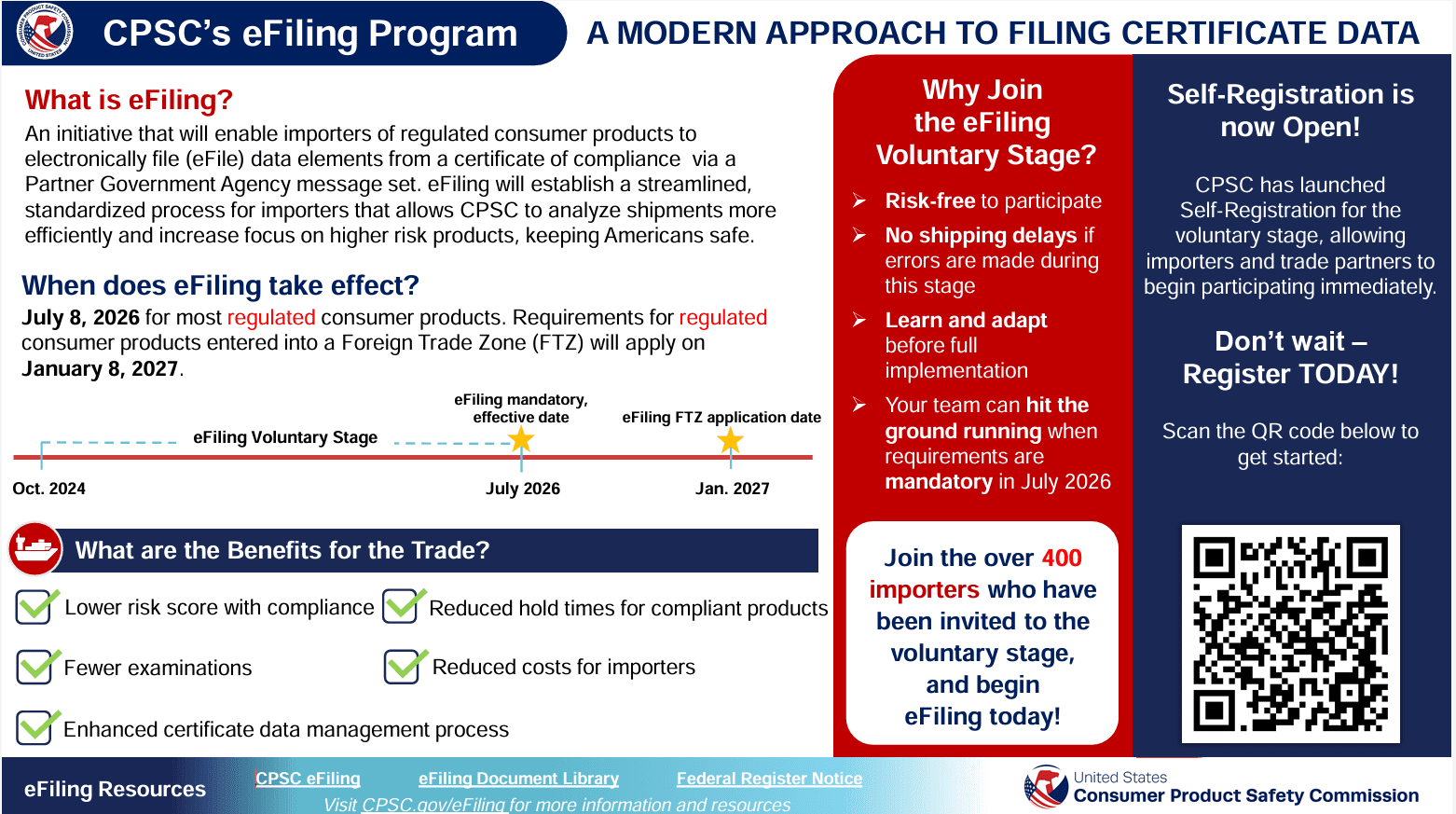
The CPSC’s new system is a step toward more transparent and traceable compliance processes. By preparing now, home furnishings retailers can help lead the way in setting high standards for product safety and responsible importing. Our industry has raised several concerns about the rollout and implementation of the E-Filing system, as even a minor mistake can result in significant delays.
For questions or support, don’t hesitate to reach out to HFA. We’re here to help you navigate the road ahead.
How Inventory Management Can Improve the Customer ExperienceInventory management plays a big role in customer satisfaction. Inventory management should be designed to monitor product availability, but thanks to advanced technology, it can do so much more than that. Inventory management can tell you when to reorder products, help fulfill orders faster, identify what’s selling fast, and so much more. All the benefits of inventory management can improve the customer experience, ultimately driving sales. While you may need to invest in inventory management, it’s a worthy investment. To free up cash to improve inventory management systems, you may need to get funding for inventory. Continue reading as we delve into inventory management and funding.
What is inventory management?
Inventory management is the process of ensuring you have sufficient inventory to sell while maintaining a stable cash flow. It involves tracking inventory from the manufacturer to the point of sale. The purpose of inventory management is to ensure the right products are in the right place, at the right time. Furthermore, it allows retailers to ensure they always have enough inventory on hand.
Inventory management involves the following:
- Keeping track of inventory allows you to know exactly how much of each product you have in stock.
- Ordering more products to keep up with demand and cutting down on products that aren’t selling as well.
- Make sure you have backup plans if you are low on a product that’s in demand. For example, you may have a variety of wholesalers you use, so if one is out of a product you need, you can order from another supplier.
- Managing inventory from raw materials to finished products.
- Efficiently streamlining inventory to avoid shortages.
Why is inventory management important?
Inventory management is important for a variety of reasons, including the following:
- Inventory management and customers: The main reason inventory management is important is that it increases customer satisfaction. If you are on top of your inventory, you will be less likely to sell out of products or promise an order that you can’t deliver. This means customers will get their products without having to wait for backorders. It will also make them less likely to go to a competitor for the products they need.
- Helps grow business and reputation: Keeping track of your inventory will help you determine which products are selling and which are not. As a result, you can invest in the products that sell and spend less on the products that don’t. This should result in higher income and reduced losses, allowing your business to be more profitable overall.
- Minimizes shrinkage: Shrinkage occurs when items of inventory are recorded in accounting records but are no longer present in the actual inventory. This is typically due to clerical error, damaged goods, or theft. Inventory management helps companies account for shrinkage. It allows them to identify the source of shrinkage, so it’s less likely to occur.
Types of inventory
A company can have several types of inventory. They will vary depending on the type of goods you sell, but can include the following.
- Finished goods are finished products sold to customers.
- Raw materials are the materials used to produce finished goods.
- Work in Progress (WIP) refers to unfinished goods that have not yet progressed through the manufacturing process.
- MRO goods: MRO stands for Maintenance, Repair, and Overhaul (MRO). MRO goods refer to the inventory used to support the manufacturing process.
- Safety stock refers to the additional inventory a business maintains in stock to mitigate supplier shortages and address demand increases.
How does inventory management influence customer satisfaction?
Inventory management influences customer satisfaction in several ways, such as:
- Fulfillment of orders: Inventory management ensures that orders are fulfilled, allowing customers to receive their items quickly and avoiding the need to visit another furniture retailer for the items they require.
- Customer service: When furniture warehouses are well organized and products are in stock, goods can be shipped to customers quickly, providing a high level of customer service.
- Seasonality: You must consider seasonality in your inventory management processes. For example, you may want to increase your stock on casual patio sets when temperatures heat up and order more dining sets when the holidays arise. Having the right products when you need them will help capture more sales while delivering what customers want, when they want it.
- Preventing stockouts: A stockout occurs when a customer orders a product, and you don’t have it in stock. You must then inform your customer that the item isn’t available and either refund their money or place the item on backorder. Stockouts can negatively impact your store’s reputation and reduce customer acquisition and retention rates.
- Returns: A straightforward return process can significantly enhance customer satisfaction. If a customer receives an item that arrived damaged, they may want to exchange it for a product that’s in good condition. If you have sufficient inventory, you can swap it out quickly, providing a prompt return process that makes the customer happy.
How can inventory management tools help?
Once upon a time, inventory management meant retailers had to count their products manually, which was extremely time-consuming and produced a high margin of error. Today, inventory management tools are available that make the process easier and more accurate. You can even automate inventory management, accounting for products that are bought and sold in real time.
Tools that are commonly integrated into the inventory management process include:
- Data analytics: Data analytics involves using real-time data to scale your inventory up or down in a timely manner, thereby boosting profits and reducing expenses. Data analytics will also provide insight into trends and market opportunities.
- Product Segmentation: Product segmentation involves categorizing your products according to characteristics such as market appeal, profitability, and supply and demand patterns. This will enable you to determine when inventory needs to be replenished. It will maximize profits, reduce operational costs, and enhance the overall efficiency of your inventory management processes.
- ABC Analysis: ABC analysis involves categorizing products based on their sales performance. Products in the A group will be those that sell the best. Products in C groups are those that aren’t selling well. Products in the B group are products that are selling, but not as well as those in the A group. B group products should be monitored to determine which group they ultimately fall into, A or C. ABC analysis ensures that you are investing in products that sell, rather than spending money on those that don’t.
Part of an effective inventory management process is maintaining an adequate stock level. Losing a customer or sale as a result of not having a product in stock once or twice may not be the demise of a business. But when this happens regularly, it can be. Customers need to know they can count on your store. From an initial order to a return or exchange, furniture stores should maintain sufficient inventory to fulfill orders. Furthermore, you should have an easy ordering process. With inventory management tools in place, customer processes can be simplified, and fulfillment can be expedited.
Inventory Funding
Inventory funding can free up cash flow, allowing retailers to enhance their inventory management. It also ensures that retailers have a wide selection of products to sell. At the end of the day, customers are the lifeblood of your furniture store. Retail owners should strive to deliver unmatched service. Disorganized internal operations will be reflected in the customer experience. Retailers with organized and effective inventory management systems in place can improve customer satisfaction.
How Kickfurther can help
Kickfurther is the world’s first online inventory funding platform, enabling small businesses to access funds they would otherwise be unable to acquire through traditional sources. For companies that sell physical products or non-perishable consumables and have revenue between $150k $15mm over the last 12 months, Kickfurther can help. We connect brands with a community of backers who help fund inventory on consignment, providing brands with the flexibility to repay their backers as they receive cash from sales.
Kickfurther can help startups and small businesses fund millions of dollars of inventory at costs up to 30% lower than the competition. With more than $100 million in inventory funded to date, Kickfurther can help you get funded within a day or even minutes to hours.
Shape the Entire Furniture Buying Journey with LTO
Nearly 40% of U.S. consumers are non-prime, and their needs shape how they research and shop with furniture merchants.1 New findings from Koalafi’s State of the Lease-to-Own Consumer Report show that when lease-to-own financing is available, visible, straightforward, and easy to understand, shoppers feel more confident in continuing their journey and coming back. For merchants, this means more opportunities to attract high-intent customers, increase sales, and build loyalty through a better experience.
Research and discovery: visibility determines where customers shop
Many non-prime consumers begin their furniture search with urgent needs and limited budgets. For them, financing is essential. When they can’t find a payment option that works, they often leave quietly. Koalafi refers to this silent drop-off as invisible risk: the loss of high-intent customers who never engage because financing was difficult to obtain.
- Koalafi’s research found that 64% of lease-to-own consumers would have gone elsewhere or skipped the purchase entirely if financing was not available.2 This decision typically occurs early in the journey, often before a consumer interacts with a store.
- Nearly one-third of the lease-to-own consumers surveyed start their research for large purchases with a search engine, making early, clear messaging about financing critical.2
When lease-to-own options are promoted upfront, merchants meet consumers at the moment they are deciding where to make a purchase.
Purchase decisions: lease-to-own changes how much customers buy
Once consumers find a merchant they trust, lease-to-own influences what they choose and how much they spend. The report shows that financing does more than prevent walkaways; it expands the range of products customers feel comfortable purchasing.
- According to Koalafi’s data, 49% of consumers spent $250 or more than they had planned because lease-to-own options were available.
- Nearly 20% selected a higher-quality or more expensive item than they intended.2
For furniture merchants, these shifts affect outcomes across multiple categories. A consumer who is ready to buy a lower-quality sofa may instead opt for a more durable, high-quality one. A customer choosing a basic mattress may upgrade to a higher tier or complete a full room set.
The key driver is financing visibility. When financing is clearly presented on product pages, across marketing channels, and in sales conversations, customers feel confident saying yes.
Loyalty: a better financing experience leads to repeat business
Lease-to-own doesn’t just close a sale; it sets the tone for whether a customer returns. When the experience is simple, transparent, and respectful, it strengthens long-term loyalty.
Koalafi’s research highlights three factors that most influence whether non-prime consumers come back:
- A positive, respectful shopping experience
- An easy, mobile-friendly application and approval process
- In clear, simple terms, they understand
When these elements align, loyalty tends to increase.
- 70% of Koalafi’s repeat leases happen with the same merchant.3
- Many customers also expect to use lease-to-own again, with 64% likely to do so within the next year and 72% likely to recommend it to friends or family.2
For furniture merchants, this means lease-to-own is not just a conversion tool. It becomes part of the overall experience that customers remember.
Best practices for furniture merchants
Here’s what furniture merchants can do better to support lease-to-own consumers at every step of their journey.
- Make financing visible early
- Use clear lease-to-own messaging in paid search ads, website navigation, product pages, and in-store signage.
- Train sales teams so they can present lease-to-own effectively
- Educated sales associates can introduce financing early and clearly. With lease-to-own, customers may receive higher approval amounts, giving them access to higher-quality or complementary items they may not have realized were within their reach, which can lead to increased sales.
- Partner with providers that prioritize transparency and ease
- Strong approval amounts, clear terms, and simple mobile applications build trust and support repeat business.
- Keep financing visible after the purchase
- Many customers expect to use lease-to-own again. Include financing reminders in follow-up marketing and seasonal outreach.
Lease-to-own influences where consumers look, what they choose, and whether they return. For furniture merchants, promoting financing options clearly and delivering a smooth experience throughout the journey reduces invisible risk and strengthens long-term customer value.
Read Koalafi’s State of the Lease-to-Own Consumer Report to learn more.
Discover how Koalafi can benefit your store.
1 “The Consumer Credit Card Market.” Consumer Financial Protection Bureau, 2023.
2 March 2025 Koalafi data, surveying Koalafi customers.
3 Based on internal Koalafi data.
The New Customer Experience PlaybookHow Furniture Retailers Win Online in 2026
Walk into any furniture store today, and you can sense how dramatically the buyer journey has changed. Customers no longer arrive to browse. They arrive informed. They have compared brands, saved inspiration boards, tested products in AR, read reviews, and asked AI for recommendations long before they step inside a showroom.
And here is the shift that matters most in 2026.
Most furniture purchase decisions are now made online, even if the transaction is completed in-store.
For retailers and manufacturers across North America, this reshapes the entire customer experience. In Solvea’s 2026 Home and Furniture Industry Trends Report, one theme rises above the rest.
Online customer experience is now the strongest predictor of conversion, loyalty, and average order value across every furniture category.
Customers do not distinguish between online and offline. They expect a seamless brand experience, a unified path to purchase, and no friction. This is the new battleground for growth.
Why Online Customer Experience Now Determines Market Leaders
1. Online experience decides whether shoppers visit your store at all
Three major forces reshaped consumer behavior across North America in 2024 and 2025:
- A surge in home renovations and new builds
- Higher showroom costs pushed retailers to scale digital storefronts
- Rising expectations shaped by AI-driven search and immediate answers
Your website, product detail pages, and digital catalogue now function as your real front door. If the online experience is slow, incomplete, or confusing, customers will instantly move on.
2. Manufacturers are facing the same pressure
Manufacturers who once relied entirely on retailers to own the customer journey are now expected to deliver:
- Product configurators
- Virtual showrooms
- AR visualization
- AI-powered product support
- Clear and educational product content
When manufacturers help customers understand, compare, and visualize products online, retailers benefit, and the brand gains a competitive advantage. Shoppers will not tolerate inconsistent or unclear product data across channels.
What a High-Performance Online Experience Looks Like in 2026
Furniture is still a considered purchase, but how customers conduct that consideration has changed entirely. The leaders share five traits.
1. Personalization that feels helpful rather than intrusive
Customers want guidance, not pressure. Winning strategies include:
- Curated room bundles based on browsing patterns
- Recommendations that match the saved room dimensions
- Automatically saved product views
- Suggestions for compatible items
Solvea data shows that conversion increases by nearly thirty percent when personalization feels like support rather than surveillance.
2. Dynamic and interactive merchandising
Static content is no longer enough. Shoppers expect:
- Interactive product spins
- Material close-ups
- Modular configurations
- AR previews within their room
- Inspirational shop for the room layouts
- Smart product question answering
These features reduce uncertainty and increase confidence in making a purchase.
3. Full transparency on delivery, assembly, and returns
North American customers now value clarity more than speed. They want to understand:
- Delivery windows
- Real-time tracking
- Assembly difficulty
- Packaging dimensions
- The return or exchange path
Solvea insights show that clear delivery expectations reduce customer support volume by more than half.
4. Consistent information across retailers and manufacturers
When customers research a manufacturer’s website and make a purchase through a retailer, they expect complete alignment between the two. That includes:
- Matching product details
- Consistent price ranges
- Identical visuals
- Accurate availability and lead times
Any mismatch introduces hesitation. Market leaders are solving this by sharing product content libraries and synchronizing data across their retail networks.
5. AI as the new first touchpoint
AI strengthens the customer journey by supporting the top of the funnel. Retailers use AI to:
- Answer product questions instantly
- Compare items
- Guide shoppers to the right size or style
- Suggest alternatives when products are unavailable
- Help shoppers build room concepts
Solvea data shows that AI can resolve more than 40% of online interactions without escalation. This allows human teams to focus on complex, relationship-driven conversations.
How Retailers and Manufacturers Can Elevate Online CX in 2026
Here is the Solvea framework for improving the digital customer journey and increasing customer confidence.
1. Audit your digital storefront
Evaluate the fundamentals:
- Page speed
- Navigation flow
- Product detail completeness
- Mobile performance
- Content quality and accuracy
Your website is now your showroom and requires the same care and discipline.
2. Address confidence gaps that reduce conversion
Look for friction points such as:
- Missing reviews
- Lack of fit, size, or material details
- Unclear warranty guidance
- Confusing delivery expectations
- Vague return processes
Each of these creates hesitation at the moment of decision.
3. Align retailers and manufacturers on product data
Leading brands centralize product information and ensure that every digital touchpoint displays accurate, synchronized content. This eliminates confusion and builds trust.
4. Introduce AI across the entire shopper journey
AI elevates:
- Discovery
- Product education
- Recommendation relevance
- Support efficiency
- Personalization quality
- Cart recovery
When used responsibly, AI can shorten the buying cycle and increase customer confidence.
5. Convert customer feedback into continuous improvement
Reviews and support tickets reveal the next opportunities to optimize:
- Delivery friction
- Assembly issues
- Missing details on product pages
- Photography gaps
- Expectation mismatches
Every improvement made here directly affects revenue and lifetime value.
The Overlooked Power of Post-Purchase Experience
Most furniture retailers lose customer satisfaction after the transaction because communication drops off during the delivery window. This is exactly when customers want the most support.
Post-purchase excellence includes:
- Order updates
- Delivery countdown alerts
- Assembly guidance
- Product care instructions
- Proactive support outreach
Solvea research shows that post-purchase engagement has the most substantial impact on the Net Promoter Score in the furniture category.
The Takeaway: Your Online Experience Is Your New Competitive Edge
Customers will forgive a limited showroom or a delayed restock, but they will not forgive a frustrating online experience.
Online customer experience is now:
- The primary driver of brand preference
- Your most scalable sales channel
- The deciding factor in store visits
- The biggest predictor of loyalty
The brands that master digital experience will define the next era of home and furniture leadership.
Level Up Your Digital Customer Experience With Solvea
The next era of home and furniture leadership will belong to the brands that deliver clear, confident, and seamless online experiences. Solvea helps retailers and manufacturers enhance every step of the customer journey with AI-powered product guidance, automated support, and unified product data, thereby strengthening conversion and loyalty.
If you want to improve online customer experience and prepare for the 2026 market shift, Solvea can help.
Explore how leading brands are using Solvea to:
- Increase conversion with intelligent product answering
- Reduce support volume with automated resolution
- Improve product confidence through complete and consistent content
- Strengthen retailer and manufacturer alignment
- Increase customer satisfaction throughout delivery and post-purchase
Get the full 2026 Home and Furniture Industry Trends Report and the 2026 Retail eCommerce Playbook here and book a complimentary AI assessment to see what is possible.
A New Era of Retail How Technology is Redefining Visual MerchandisingVisual merchandising has evolved significantly from traditional window displays and static store layouts. What used to rely solely on creativity and aesthetics has now evolved into a seamless blend of art, science, and technology.
In today’s retail landscape, technology doesn’t just support visual merchandising — it defines it. From immersive digital displays to interactive 3D visuals, retailers are now crafting environments that engage all senses, whether in-store or online. This shift marks the rise of tech-driven visual merchandising, where creativity meets data and innovation shapes every customer interaction.
The Shift from Static Displays to Dynamic Experiences
Shoppers today don’t merely want to look at products — they want to interact with them. Gone are the days of traditional window installations and basic online product images. Today, customers expect digital experiences that cater to their needs, tastes, and interests.
Contemporary visual merchandising isn’t merely about making something attractive anymore — it’s about making something interactive, customized, and immersive. Let’s dive into how that’s occurring. According to studies, over 60% of customers report that they would like brands to provide AR experiences. Additionally, items with 3D/AR content can track conversion rates up to 94% higher than products without these experiences. It’s not just a novelty — it eliminates returns, boosts confidence, and converts occasional browsers into repeat customers.
● Virtual Room Visualization
The biggest leap in furniture and décor merchandising comes from AR and 3D-powered room visualization tools. Instead of static images, customers can now virtually place furniture in their own rooms — checking for scale, style, and fit before purchase.
For example, IKEA’s “Place” AR app allows users to place virtual furniture pieces in their real spaces, enabling 3D inspection of scale, material, lighting, and fit.
Similarly, Wayfair’s “View in Room 3D” feature lets users visualize over 18 million products at scale within their homes.
These innovations don’t just make the experience more fun — they build confidence, reduce return rates, and create emotional connections with products long before purchase.
● 3D Product Spins
One of the strongest innovations in eCommerce is moving from fixed product images to 360° 3D product spins. Instead of flipping through a gallery, customers can rotate, zoom, and inspect every angle of a product as if it were right in front of them.
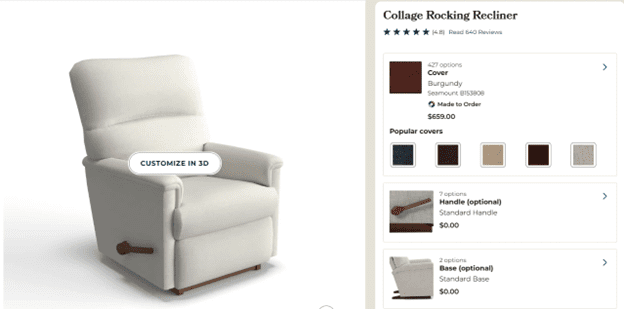
For example, Ashley Furniture’s 360° product viewer allows shoppers to interact with sofas, recliners, and tables in real-time, bridging the gap between digital and in-store experiences. Similarly, La-Z-Boy’s 3D product views enable customers to evaluate texture, color, and proportions in a tactile manner — without ever visiting a showroom.
This subtle visual shift makes a significant difference, providing customers with the sense of touch and assurance that traditional online photos can’t deliver.
● Interactive Configurators
Today’s shoppers expect personalization. They don’t just want a sofa — they want their sofa, in the color, size, and finish that fits their exact taste.
Interactive 3D configurators make that possible. Shoppers can mix and match materials, change finishes, and instantly visualize each variation.
For instance, Joybird allows users to customize sofas and chairs by changing the upholstery and legs in a live 3D preview. Interior Define takes it a step further by offering complete 3D configurators for made-to-order furniture — customers can modify every dimension and watch the design update in real-time. For brands, configurators mean fewer returns, better engagement, and a faster path to purchase.
Technologies Powering Modern Visual Merchandising
Behind these compelling experiences are robust technologies that enable brands to plan, visualize, and customize every aspect of their customer experience.
● 3D Visualization
3D visualization forms the backbone of present-day digital merchandising. Through photorealistic 3D renders, brands can present every conceivable version of a product — color, material, texture, and configuration — without ever conducting a photoshoot.
It’s quicker, more agile, and endlessly scalable. Brands like Pottery Barn and West Elm use 3D visualization to create hundreds of lifestyle images for online catalogs. Platforms like imagine.io make this process even more seamless, enabling marketing teams to produce photorealistic renders, create 360° visuals, and design fully interactive configurators within minutes.
● Augmented & Virtual Reality (AR/VR)
AR and VR are revolutionizing the home furnishing experience — both online and in-store.
Lowe’s leverages AR through its “View in Your Space” feature, which allows customers to preview how flooring, lighting, or furniture pieces fit into their homes. Meanwhile, IKEA’s Room Planner and IKEA Kreativ enable users to scan their rooms, digitally remove existing furniture, and place new products virtually for complete design visualization.
Virtual showrooms are also on the rise. Herman Miller and Crate & Barrel have experimented with VR-enabled virtual stores, providing customers with an immersive, walkable 3D experience of their entire collections. These technologies eliminate guesswork, enhance confidence, and make shopping for large home items both enjoyable and interactive.
● AI-Powered Layout Design
Artificial Intelligence is adding a new layer of intelligence to merchandising. AI can now analyze store traffic patterns, product performance, and customer behavior to optimize both digital and physical layouts.
Wayfair’s AI-driven visual recommendation engine suggests furniture combinations and décor items that match a user’s browsing patterns.
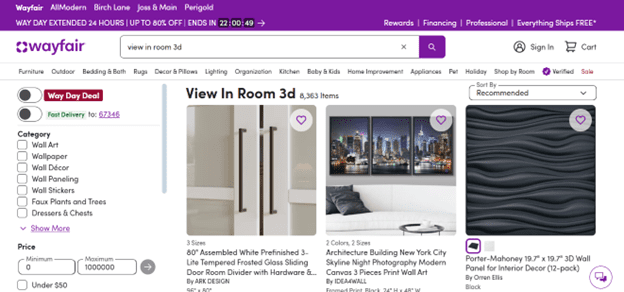
In physical retail, brands such as Lowe’s and Ashley Furniture are utilizing AI insights to enhance store layouts, ensuring that high-traffic products are displayed in optimal positions.
For eCommerce, AI algorithms can even auto-generate visual sets and scenes that resonate with customer data, helping merchandisers design smarter, faster, and with measurable precision.
● Data-Driven Insights
Creativity and analysis go hand in hand in contemporary merchandising. Now, retailers apply consumer behavioral data to know what is working — monitoring metrics such as:
- How long consumers interact with an interactive display
- Which product images perform best
- What colors or patterns generate the most clicks or interest
This evidence-based feedback loop enables teams to continually hone visual strategies. Brands can no longer rely solely on intuition; instead, they design on the basis of evidence — and refine their aesthetic appeal and conversion rates over time.
Real-World Examples: Retailers Leading with Tech
The world’s most successful retail brands aren’t just following tech trends — they’re setting them. By blending creativity with cutting-edge visualization tools, these innovators are redefining what it means to shop, both online and in-store.
● Chairish: AR-Powered Vintage Décor Visualization
Chairish, an online marketplace for high-end and vintage furniture, uses AR technology to help shoppers visualize how unique décor pieces will look in their actual spaces. Through its mobile app, customers can virtually “place” items like sofas or chandeliers, making it easier to gauge scale, fit, and style before purchase — reducing uncertainty and improving buying confidence.
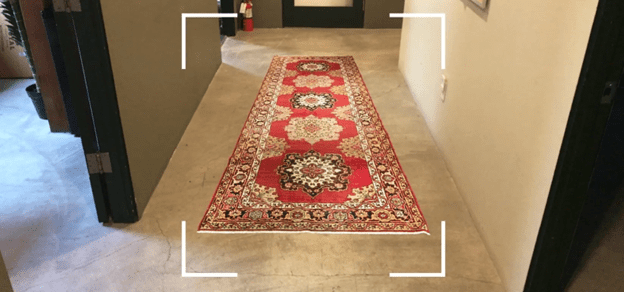
● Ashley Furniture: Virtual Home Makeovers with AR
Ashley Furniture has transformed its shopping experience with an AR-powered mobile app that allows customers to drop 3D furniture models directly into their homes. Shoppers can experiment with layouts, materials, and colors in real time — turning inspiration into instant visualization. This hands-on experience bridges the gap between online and in-store browsing.
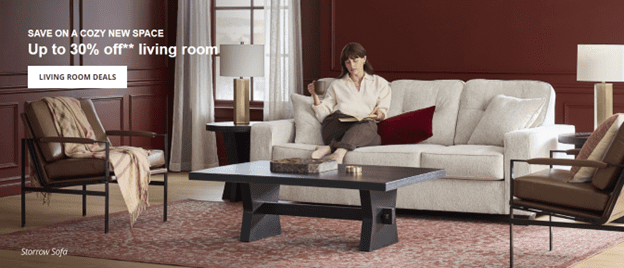
● La-Z-Boy: 3D Customization for Personalized Comfort
La-Z-Boy, one of America’s most recognized furniture brands, has embraced 3D visualization and product configurators to help shoppers personalize their furniture. Through its “Design Your Own” feature, customers can choose from hundreds of fabric options, colors, and finishes while instantly previewing their customized sofa or recliner in photorealistic 3D. This interactive experience not only simplifies decision-making but also enhances customer confidence — bridging the gap between in-store consultations and digital exploration.
These innovations prove that technology doesn’t just enhance the shopping experience — it personalizes it. And the best part? You don’t have to be a global brand to start. Platforms like imagine.io make advanced visualization tools accessible to any business. Whether you’re a growing furniture brand or a boutique home décor label, you can create high-quality 3D visuals, product spins, and interactive configurators that rival enterprise-level production — all without a massive budget.
How Visual Tech Enhances the Customer Experience
Combining visual merchandising with digital technology doesn’t just bring the store up to date; it alters consumers’ experiences, interactions, and purchasing decisions. From the moment customers become aware of a product to making their final purchasing decision, visual technology communicates levels of confidence, connection, and simplicity.
● Deeper Engagement Through Interactivity
Interactive pictures, such as 360° spins, AR try-ons, and 3D room planners, invite consumers to interact with products more deeply. Instead of just passively scrolling through images, consumers are active participants — zooming in on details, defining finishes, and observing how they live with products. Such do-it-yourself interaction translates into longer browsing time and purchase intent.
● Building Confidence with Realistic Visualization
When consumers get to view realistic 3D or AR product simulations, confusion vanishes. They can visualize exactly where a sofa will go in their living room or how a lamp will complement their decor — removing uncertainty and reducing returns. Such precision fills the gap between browsing online and real expectations.
● Maintaining Brand Consistency Across Channels
Technology helps a brand’s visual story remain consistent across every touchpoint — from in-store displays to mobile apps and online catalogs. Dynamic visual asset management systems enable easy updates, reuse, and coordination of visuals across campaigns, ensuring customers consistently receive a unified brand appearance.
● Enhancing Convenience and Decision Speed
In an era of fleeting attention spans, speed matters. Technologies like product configurators and instant visualizers enable quicker customer decision-making — eliminating the need for delayed waiting on physical samples or hand-drafted mockups. By rationalizing clunky buying procedures, visual tech accelerates the path to purchase and boosts conversion rates.
Done correctly, visual technology transforms a transactional process into an emotional experience — one of inspiration, trust, and joy — driving every decision.
The Future of Visual Merchandising
The future of retail is smarter, more adaptive, and powered by AI. We’re transitioning from static displays to predictive and personalized environments that evolve in real-time based on data and customer behavior.
● Generative AI in Visual Design
AI-powered design software will be capable of creating adaptive imagery and shelf layouts in real-time — delivering distinctive shopping experiences to each shopper segment. Picture an AI that automatically reorganizes fixtures based on best-selling merchandise, time of year, or even regional tastes — no human intervention necessary.
● Omnichannel Merchandising
Retail tomorrow will not separate “online” and “offline.” Rather, it will blend both into an invisible fusion. Imagine a shopper exploring online, bookmarking a bookmarkable 3D model of a product, and then seeing it in front of them through an AR-enabled in-store display — each touchpoint tying together in one visual language.
● Predictive Retail Environments
Physical environments are becoming intelligent. AI and IoT will soon enable stores to respond in real-time — adjusting lighting, screen content, or promoted displays based on demographic audience, time of day, or even weather conditions. The outcome? Extremely personalized environments that react to shoppers naturally.
Blending Creativity with Technology
Technology has redefined visual merchandising from a static display practice into a dynamic, data-driven discipline. Today, it’s not just about arranging products — it’s about crafting immersive, intelligent, and interactive experiences that resonate across every channel.
By integrating 3D visualization, AR tools, and AI-driven automation, brands can design adaptable merchandising strategies that respond to customer behavior in real time. This fusion of creativity and technology enables faster decision-making, personalized engagement, and consistent brand storytelling — both online and in-store.
As visual technologies continue to evolve, the most successful brands will be those that view innovation not as a trend, but as a foundation for more meaningful and measurable shopping experiences.
Customer Experience Personalization: How to Use Data ResponsiblyPersonalization has moved from a nice addition to a core expectation in modern retail. Customers want brands to understand their preferences, respect their time, and offer experiences that feel relevant and helpful. At the same time, shoppers are more protective of their privacy than ever. They are quick to sense when a brand crosses the line from supportive to intrusive, and they disengage quickly when that happens.
This tension is especially significant in high-consideration categories, such as furniture, where decision cycles are long, product discovery can be overwhelming, and shoppers rely heavily on online research before visiting a store. Brands want to deliver meaningful and timely guidance, but they also want to avoid the perception that they are over-informed. The challenge is meeting rising expectations without compromising trust.
A McKinsey study found that 71% of consumers expect companies to deliver personalized interactions, and 76% become frustrated when they do not receive them. That frustration often results in lower engagement, fewer return visits, and lost sales. Yet customers do not want personalization that feels invasive. They want personalization that makes their journey easier.
This is where responsible personalization becomes essential. It allows brands to offer meaningful, timely relevance without crossing into discomfort. It turns data into a source of clarity, not concern. And it builds a relationship rooted in trust rather than surveillance.
Make Personalization Feel Helpful, Not Hyper Aware
Most customers welcome personalization when it clearly helps them. Showing complementary products that match their interests, recommending alternatives when something is out of stock, and highlighting items that fit their demonstrated style all convey a sense of support. These types of experiences simplify choice and give shoppers a sense of direction.
The discomfort arises when personalization becomes too specific or suggests an overfamiliarity with the customer’s life. Customers should feel that the personalization is based on actions they have taken, not on data coming from unknown sources. The safest and most effective principle is to personalize based on behavior, not biography. Use browsing signals and engagement patterns rather than assumptions or sensitive personal information.
When personalization remains connected to what the customer has actually shown interest in, it feels natural and earned.
Use Data to Add Clarity, Not Complexity
Customers often feel overwhelmed by the vast array of options available, especially in furniture, where products vary widely in style, size, materials, and price. They visit multiple sites, compare dozens of items, and try to make sense of information that is not always easy to interpret. This is where many shoppers abandon the process entirely.
Data-driven personalization should solve this problem by reducing the noise and surfacing what matters. Instead of presenting everything in the catalog, it should highlight options that align with the shopper’s demonstrated intent. Instead of sending broad messages, it should offer guidance that narrows the field and helps them make a confident choice.
When personalization eases decision-making and removes overwhelm, customers welcome it because it makes the journey more enjoyable and less stressful.
Be Transparent in Ways Customers Notice
Customers do not need a detailed explanation of your data practices to feel comfortable. They simply need to understand why they are seeing a particular recommendation or message. When personalization clearly connects to past behavior, it feels transparent.
For example, reminding them of products they viewed or showing coordinating pieces based on something they clicked establishes a clear link between their action and the personalization they receive. When customers understand the logic, the experience feels predictable and trustworthy.
This subtle transparency creates comfort by showing that the personalization is coming from their own engagement, not from unrelated or private data.
Focus on Intent, Not Identity
The most responsible form of personalization does not rely on personal identity. It relies on understanding what the shopper is trying to do. Intent-based personalization uses signals such as browsing behavior, category interest, and product comparisons. These clues reveal the shopper’s mindset, allowing brands to tailor experiences without accessing sensitive data.
Customers feel respected when personalization reflects their intent rather than their personal attributes. This approach strikes a balance between relevance and privacy protection. It also creates more accurate personalization since it aligns with real-time behavior rather than static profiles.
Give Customers Control Over Their Experience
Personalization feels most comfortable when customers can shape it themselves. Allowing them to favorite products, save collections, compare items, request reminders, or build inspiration boards gives them a sense of agency. The more a shopper can guide the experience, the less personalization feels imposed.
When customers feel that personalization is something they participate in, rather than something the brand imposes on them, trust grows naturally. They view the brand as a partner in their journey, not a bystander to their behavior.
Think Long Term, Not Just Immediate Conversion
Some brands approach personalization with a short-term mindset, focusing on tactics that drive quick conversions. While these strategies may be effective in the short term, they often erode trust over time. Responsible personalization takes a broader view. It aims to support the shopper at every stage of the journey, from early inspiration to final purchase and beyond.
This approach emphasizes consistency, relevance, and helpfulness rather than pressure. It respects the customer’s pace and preferences. When brands adopt a long-term mindset, they foster loyalty, enhance lifetime value, and create experiences that customers eagerly anticipate.
Build a Personalization Strategy Aligned With Your Values
Customers can easily sense whether a brand uses data to serve them or to exploit their behavior. The most successful brands understand that trust is the foundation of personalization. They use data with intention, restraint, and clarity.
Responsible personalization does not limit what a brand can achieve. It simply ensures that every data-driven action aligns with the customer’s comfort and expectations. When personalization feels intelligent and respectful, it strengthens the relationship and enhances loyalty.
In a world where customers expect relevance but reject intrusion, the brands that win are the ones that deliver personalization that feels thoughtful, transparent, and human.
How 3D Gives Furniture Shoppers the Clarity They Seek: A Raymour & Flanigan Case StudyFurniture is deeply personal. Every day, we meet customers who are excited about finding the right piece, yet also understandably nervous. A shopper discovers a sectional they love, tests the comfort, scrolls through images online, and then pauses with the same questions we hear again and again:
- Will this really fit?
- Will it match my décor?
- What does it look like from every angle?
- If I customize it, what does that version actually look like?
These questions aren’t hesitations, they’re smart decisions. Furniture is a meaningful investment in someone’s home and daily life. That’s exactly why 3D tools have become so important as part of Raymour & Flanigan’s customer experience process. They give customers the clarity and confidence they deserve, whether they begin their journey online or walk straight into one of the Raymour & Flanigan showrooms.
When Imagination Isn’t Enough
Furniture shopping has always required visualization. Online, customers see measurements and a handful of photos, but that doesn’t always translate into how a piece will feel in their home. In a showroom, they can experience comfort, quality, and fabrics—yet still wonder how everything will work with their layout or lighting.
We hear it constantly: “I just can’t picture it in my room.”
Most people aren’t trained to visualize scale or color combinations, and custom sectionals add even more possibilities. Many collections include combinations that no physical showroom could fully display.
That’s where 3D steps in.
It closes the gap between imagination and certainty.
How 3D Tools Support Confident Purchase Decisions
Augmented Reality Removes the Guesswork
With AR, customers place a true-to-scale piece right inside their home using only their phone. They instantly see:
- How the furniture fits
- How much space does it leave
- How the fabric works with their existing décor
What used to feel overwhelming becomes a moment of confidence. Customers can make decisions grounded in how they actually live—before they ever step into a store.
Visual Sectional Configuration Expands What’s Possible
Our sectional configurator has transformed how customers shop and how our associates guide them. It shows only valid configurations, lets customers rotate and view every angle, updates measurements in real time, and helps people understand scale instantly.
In stores, our team can recreate or modify what a customer explored online—whether they want to adjust size, change arms or bases, swap fabrics, or simply compare options side by side. It turns “I think this could work” into “I know this will work.”
Better Fit, Bigger Confidence, Easier Decisions
Recently, a customer planned to buy a three-piece Artemis sectional. After learning they had more space at home, we opened the configurator and showed them a larger version in their preferred fabric. Seeing it visually helped them choose a layout that truly fit their room—and how they planned to live in it.
Another customer came in after building a configuration of our Enbright sectional online. They were curious how it would look in a slightly different setup, so we opened their saved layout and explored variations together. Seeing their original design—and how easily it could be adapted—made the decision straightforward and reassuring.
This pattern is becoming the norm: customers start online, explore in detail, then come into the showroom to confirm, compare, and complete their vision. The experience feels natural and connected—exactly how shopping should feel.
3D Tools Prepare Customers Before They Even Walk In
We’ve noticed a clear trend that customers spend more time on product pages when 3D tools are available. They explore deeper, answer their own questions, and understand their options before they even connect with us. Those who use 3D often show stronger intent—whether they continue online or visit a showroom. And far from replacing the in-store experience, these tools help customers arrive more prepared, more confident, and more excited.
Furniture shopping is no longer a straight line. It’s a loop between home and showroom, digital and physical—and 3D makes that loop feel seamless.
What’s Next for 3D at Raymour & Flanigan
We’re expanding our 3D program with 3D Cloud 3D visualization software across more categories and SKUs, as the value is undeniable. These tools aren’t “nice to have” anymore; they’re becoming essential.
3D helps customers:
- Visualize their space
- Explore customization options
- Understand scale and fit
- Make decisions they feel great about
Whether a shopper begins on their sofa or in ours, we want the experience to feel connected, clear, and rooted in real-world confidence. That’s the Raymour & Flanigan standard—supporting customers every step of the way as they create the comfort of home.
3D tools by 3D Cloud help us do exactly that.