Inventory is your biggest asset, but also your biggest expense. Manicuring and curating your inventory assortment is the most important job you have. It’s very easy to get distracted by other things in your business. Still, your inventory is the best place to invest your time, and in doing so, you’ll ensure better cash flow, profitability, and margins.
Sounds great, but what do you actually do to make that happen? The key is Turnover Rate, or Turn.
First, we need to establish some goals. Does your business have sales goals that you believe in? If not, you need to take some time to establish viable, achievable, believable sales goals so that you can plan out how much inventory you need. To be truly effective, those goals should be categorized by month and by location (if you have more than one store).
Once you’ve established the sales goals, the next step is to plan your inventory levels to achieve those goals without underbuying and missing sales or overbuying and tying up cash. In all my years of experience, whenever I talk to a store with good sales but bad cash flow, it’s always been true that they’re holding on to too much inventory. Sure, you can find other areas of expense that will help with cash flow, but the elephant in the room (or the warehouse) is the level of inventory that you’re holding on to.
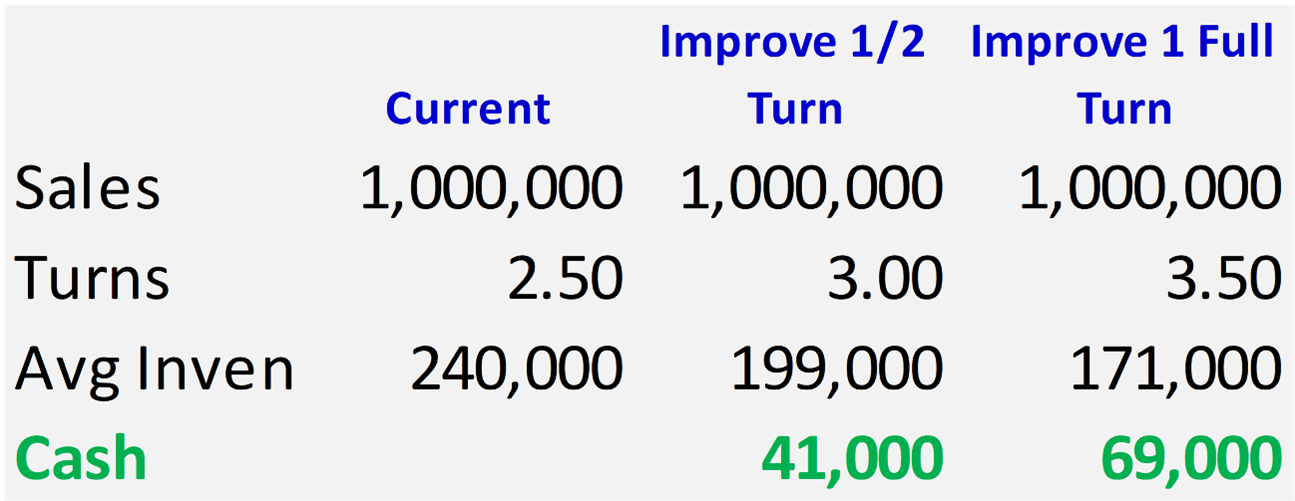
The chart above shows the potential cash flow improvements from just a slight improvement in the turn. If you have a store doing $1 million in sales per year, and you are turning your inventory at 2.50, you’re keeping an average inventory of $240,000. If you could improve your inventory turn by just .50, you would effectively lower your inventory investment to $199,000, and you’d put $41,000 in your pocket. A full turn improvement would put $69,000 in your pocket.
Think about that for a moment. Based upon your normal margins, if you wanted to get another $69,000 in gross margin, how much more would you have to sell? In the case above, given the margins, you’d have to sell at least another $150,000 or grow the business by 15%. However, by turning faster, you get the same cash margin without having to sell another piece. Let that sink in for a moment, because it’s life-changing for most retailers.
All that said, you don’t improve your turns by just saying you intend to do that. You need a strong sales forecast, as mentioned above. Next, you have to see what your historical turns have been, so you have a basis to start from. The calculation for turn is Net Sales divided by Average Inventory. I suggest you do that calculation for the last year (Turn is an annual statistic) and by category, so that you can evaluate it on a category-by-category basis.
Once you have those numbers, you can see what improving turns in each category would contribute to your cash flow. It’s worth studying each individual category; some categories could benefit from much faster turns, some will be fine as they are, and there may even be a few that are turning too fast. If a category is turning too fast, it could mean that you are out of inventory before all your customers get a chance to purchase those products, which means you are missing sales and sending your customers elsewhere to find what they’re looking for.
As you can see, it does require a delicate balance to work through this. However, I can’t think of a more important exercise. Without it, your buying becomes random, and your profitability is at risk. I encourage everyone in retail to spend time on this. The best retailers do it often.