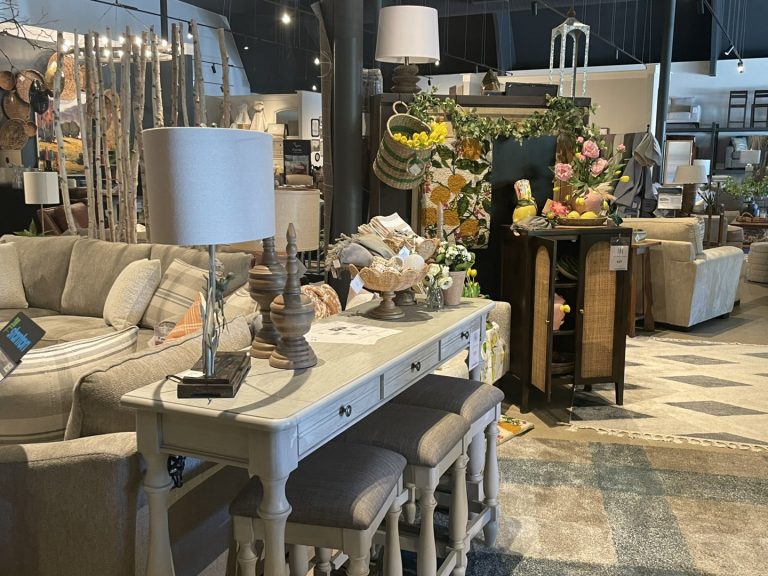
She stopped in front of the living room vignette the way shoppers do when something feels right. Hand on the arm of the sofa—a slow look at the rug, the lamp, the throw that made it feel finished.
Then came three questions in a row. Could she get this sofa in a different fabric? Was there a matching chair that wasn’t on the floor? And could the sectional she’d seen on her phone that morning arrive before her mother’s visit in six weeks?
Twenty years ago, this was when you walked to the binder. Half the time, the sale walked out with the customer.
The binder is gone, but the moment is the same. The vignette still has to win the first ten seconds. What decides the sale is everything after that: how fast and how honestly your team can answer the questions the floor can’t.
This article covers where technology helps in that moment, where it hurts, and a 15-minute audit you can run on your own floor this week.
What is the role of technology in visual merchandising?
Technology extends the merchandising story past the square footage you can afford to carry. The vignette starts the sale. Tablets, kiosks, and product pages keep it going when the next question goes beyond what you have in stock.
The showroom is not going anywhere. Even after the online surge during the pandemic years, most U.S. furniture spending still occurs offline: ECDB estimates that online channels accounted for only 20-25% of U.S. furniture revenue in 2025. People want to sit on a sofa before they spend $2,000 on it. Independent retailers know this in their bones: which corner gets afternoon light, which sofa angle stops a hurried shopper.
What changed is the shopper who walks in. Most furniture buyers now research online first: 61% of consumers shopping for furniture and home products began with online research, even though 56% ultimately bought in person. She arrives knowing your prices, your competitors’ prices, and three sofas she liked on Instagram. The vignette still sells the dream. But her questions are sharper, and she expects answers on the spot.
Shoppers who use both your store and your website are also worth more. A Harvard Business Review study of 46,000 shoppers found customers who used multiple channels spent about 4% more in-store and 10% more online than single-channel shoppers. Connecting the floor to the catalog is not a tech project. It is a way to serve your best customers.
A note on what not to do: technology does not replace the craft of a good vignette. Stores that swap storytelling for screens usually end up with both looking hollow. A wall of TVs looping product videos is not merchandising. A tablet that answers the question a customer just asked is.
Why is the furniture assortment now bigger than the showroom floor?
Customers expect more choice than any independent showroom can stock. One upholstered sofa can come in dozens of fabrics, three depths, and several configurations. You cannot floor all of that and still run a healthy business.
So many retailers now sell in two layers. The first is what you display with care on the floor. The second is what you can sell from a tablet, a kiosk, or the product page the customer opened in your parking lot. Most special orders, supplier-shipped items, and “I’ll take it in navy” sales live in that second layer.
The risk sits in the gap between the two layers. If the floor tag says one price and the tablet says another, the vignette starts to feel like a prop. If an associate promises a lead time the supplier cannot hit, a beautiful room becomes a broken promise.
The cost of that gap is real. In 2020, “failure to deliver” furniture and appliances helped put household goods in the top-ten complaint categories reported by state and local consumer agencies, and a customer burned by a lead time rarely gives you a second chance. Out-of-stocks alone cost retailers globally an estimated $1.2 trillion a year in lost sales, according to IHL Group.
I have seen this in showrooms of every size. The vignette was right. The sale still wobbled because the answer to the next question (in-stock, ETA, configuration) lived in a different system than the floor story.
Four ways technology earns its keep in a furniture showroom
Technology earns its keep by protecting both the vignette and the close. You don’t need a big rollout. Focus on these four disciplines, and start each with one small action.
1. Tell the same story on every surface
The sofa on the floor, the tablet next to it, your website, and any marketplace listing should show the same price, availability, dimensions, and images. When they don’t match, your associate becomes a translator between systems instead of a salesperson.
Try this week: Pick your five best-selling items. Check the floor tag, your website, and your POS for each. Write down every mismatch in price, name, dimensions, or stock status. Most stores find at least one on the first pass. Fix those five, then make the check a monthly habit.
2. Show what you can’t stock
Putting curated digital options next to a physical vignette is one of the highest-value moves in a small or mid-size showroom. The customer loves this sectional, so show her the other fabrics, the reversed chaise, and the matching chair and ottoman that didn’t fit on the pad.
Curate it like another wall of the room. A tablet that opens your entire 20,000-SKU catalog overwhelms. One that opens to the 8 to 12 pieces that complete this vignette sells.
Try this week: For your top three vignettes, list the five follow-up items customers most often ask for (other fabrics, the matching chair, a larger size). Make sure an associate can pull up each one in two taps from the floor, through a saved list, a QR code on the tag, or a bookmarked page.
3. Equip the associate, not just the shopper
Today’s shopper often walks in knowing more than a new associate, because she spent the evening reading product pages. Give your team fast answers to the questions customers actually ask:
| Customer question | What the associate needs within reach |
| Will this fit through my door and up my stairs? | Overall dimensions, plus whether legs or backs detach |
| How deep is the seat? Will I sink in? | Seat depth, seat height, cushion fill |
| Is this in stock, or special order? | Live stock status by location and warehouse |
| When can I have it? | A realistic delivery window, not a best case |
| What goes with this? | The matching pieces and alternate fabrics for this group |
When this knowledge lives in one veteran’s head, your sales depend on who is working that shift. The goal is for a three-month associate to answer with the same confidence as your best closer.
Try this week: Ask your newest associate the five questions above about one vignette. Time- how long each answer takes. Anything over a minute is your training or data gap.
4. Protect the close with an honest lead time
Lead time and availability should be part of the conversation before the customer leaves. Nothing undoes a great floor experience faster than “we’ll get back to you” on the one detail that decides whether the sofa arrives before the holidays.
Honesty also protects your reviews. Shoppers forgive a long lead time they agreed to. They don’t forgive a short one that slips.
Try this week: Give your team a simple rule. If the lead time is longer than the customer hoped, offer an in-stock alternative from the same story before she asks. If stock is confirmed and the date is clear, ask for the sale. Give associates a script like: “This one is about 10 weeks. If your mom’s visit is the deadline, this similar sofa in the same color family is in our warehouse and can be delivered in two.”
Is online product data part of visual merchandising?
Yes. Your website is a merchandising surface, and a thin product page loses the sale the same way a half-finished vignette does.
Shoppers say so plainly. In Salsify’s 2025 survey of 1,910 U.S. and U.K. shoppers, 77% rated product titles and descriptions, and 77% rated product images and videos, as very or extremely important to completing a purchase, and 71% had returned an item because the product content was incorrect. In furniture, a return isn’t a quick mailer. It is a truck, two people, and a damaged-goods risk.
A complete furniture page covers the same ground your best associate does on the floor:
- Overall dimensions, plus seat depth and height, and clearance or doorway notes
- Materials, fill and finish options, with a swatch for each
- A lifestyle photo that shows scale, alongside clean product shots
- Stock status and a realistic delivery window
- The matching pieces from the same collection
This matters more each year because AI search tools now answer shopping questions directly. Google says there are no special optimizations required for AI Overviews or AI Mode; the same fundamentals apply, starting with helpful, complete, people-first pages. Thin pages get skipped. Complete ones get cited and clicked.
Try this week: Open the product page for your best-selling sofa on your phone. Could a stranger answer all five points above without calling you? If not, that page is your first fix. I go deeper on this in a companion piece on online visual merchandising techniques.
The 15-minute vignette audit
Modern visual merchandising means designing the experience and the truth behind every item you sell, including the ones not on your floor. Here is how to check yours.
Pick one vignette. Stand in front of it with an associate and score one point for each yes:
- The price on the floor tag matches the website and the POS.
- The associate can show at least three items that aren’t on the floor but complete this room, in under a minute.
- The associate can say whether the hero piece is in stock or special order without leaving the vignette.
- The associate can give a realistic delivery window, not a guess.
- The website page for the hero piece shows full dimensions, materials, and finish options.
- If the lead time is long, the associate can name an in-stock alternative from the same story.
5 to 6: Your merchandising is modern in the way that matters. Run the audit on your next vignette.
3 to 4: The floor is doing its job, but the second layer is leaking sales. Start with whichever “no” comes up most.
0 to 2: Your vignettes are working harder than your systems. Fix product data first, because every other point depends on it.
The vignette starts the story. Make sure the truth can keep up.