
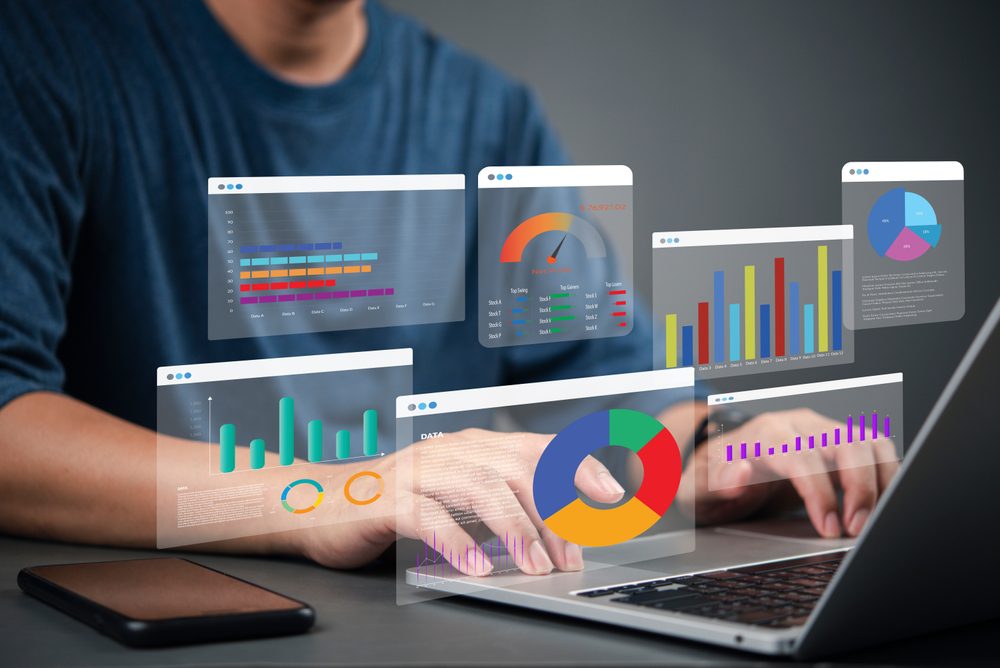
Profits don’t improve by accident. It improves when leadership can clearly see how marketing, eCommerce, product performance, and operations influence margin. Many retailers generate significant volumes of data, yet still struggle to translate it into disciplined retail profit management. Reports often live in separate systems and then in spreadsheets so teams can evaluate performance. That fragmentation does more than delay action; it creates uncertainty and quietly erodes margin over time.
A custom analytics dashboard provides structured visibility. When designed correctly, it connects ERP data, eCommerce transactions, marketing performance, and website behavior into one reporting environment. The purpose is not to increase reporting volume. The purpose is to improve clarity so teams can act decisively and protect future profits.
Retail Profit Management Starts With a Retail Analytics Dashboard
Revenue growth alone does not indicate financial strength. Retail profit management requires understanding which channels generate stronger margins, which SKUs convert efficiently, and where operational friction affects earnings. Without that clarity, teams make decisions based only on partial information. A retail analytics dashboard centralizes these insights so leadership, marketing, and sales can evaluate performance from the same dataset.
According to McKinsey & Company, organizations that extensively use customer analytics are 23% more likely to outperform competitors in customer acquisition and 19% more likely to achieve above-average profitability.
The connection between structured analytics and financial performance is measurable. Retailers that rely on fragmented reporting often delay decisions that directly influence retail profits.
A well-structured retail analytics dashboard allows teams to monitor:
- Revenue and order trends over time
- Average order value by channel
- SKU-level sales performance
- Geographic demand patterns
- Period-over-period comparisons
When these metrics are unified, teams reduce time spent validating numbers and increase time spent managing performance, shifting away from reactive reporting.
Aligning the Marketing Dashboard and eCommerce Dashboard
A marketing dashboard often tracks traffic, campaign performance, and engagement. An eCommerce dashboard typically measures transactions and conversion rates. When these reporting systems remain separate, performance conversations become misaligned. Marketing may optimize for traffic volume. Sales evaluates revenue without context around demand generation. Leadership is left reconciling two versions of performance.
Aligning the marketing dashboard with the eCommerce dashboard improves decision clarity. Website sessions can be analyzed alongside order source attribution. Organic search performance can be evaluated alongside average order value. Campaign impact can be measured against actual product revenue rather than surface engagement metrics.
This shared visibility supports both teams. Marketing can allocate spend toward channels that produce stronger order value. Sales can prioritize outreach based on category trends and regional demand shifts. When departments operate from a single retail analytics dashboard, performance discussions shift from data reconciliation to a forward-thinking strategy.
Deloitte research on data-driven organizations indicates that companies that embed analytics into operational processes are more likely to report improved efficiency and performance.
In retail environments, that alignment strengthens retail profit management by enabling every department to evaluate performance using consistent definitions and benchmarks, thereby increasing confidence in decisions.
Integration Station: ERP, Ecommerce, and Analytics in One Retail Analytics Dashboard
Ecommerce platform data alone rarely provides a complete picture of profitability. ERP systems store order history, inventory status, SKU attributes, and regional sales data. Analytics platforms capture traffic trends, engagement patterns, and search demand signals. A retail analytics dashboard becomes significantly more valuable when these systems are integrated; no longer loosely connected, but intentionally aligned.
ERP integration contributes:
- Order and revenue detail
- SKU-level performance
- Inventory visibility
- Regional sales distribution
Ecommerce integration captures:
- Transaction data
- Order source attribution
- Conversion rates
Analytics platforms provide:
- Traffic trends
- Engagement behavior
- Search query performance
When systems remain disconnected, teams manually merge reports. Gartner estimates that poor data quality costs organizations an average of $12.9 million per year.
Fragmentation increases the likelihood of inconsistencies and delayed decisions. In retail, small misinterpretations of channel performance or product demand can affect margin allocation.
Integration validates relationships between systems before decisions are made. Benchmarks remain consistent. Metrics are intentionally defined—confidence in reporting increases, strengthening retail profit management across departments.
Using an Analytics Dashboard to Improve Retail Profits
Visibility alone does not improve retail profits. Action informed by reliable data does. A retail analytics dashboard supports a structured performance cycle that connects insight to measurable outcomes.
Marketing teams can evaluate traffic quality alongside revenue contribution. If a channel generates engagement but a lower average order value, investment can be adjusted. If organic search queries indicate growing demand in specific categories, merchandising strategies can respond accordingly.
Sales teams benefit from the same clarity. SKU-level reporting highlights products that consistently drive revenue. Geographic reporting reveals regions with stronger order concentration. Order source analysis clarifies how eCommerce, wholesale, and marketplace channels contribute to overall retail profits.
A centralized retail analytics dashboard allows leadership to review:
- Revenue performance compared to prior periods
- Average order value trends
- Product category contribution
- Regional demand signals
- Channel-level revenue distribution
Retail profit management becomes proactive when these metrics are reviewed consistently. Instead of waiting for quarterly financial statements, teams monitor performance weekly. Adjustments occur earlier. Results are measured against defined benchmarks.
Over time, the retail analytics dashboard becomes embedded in the operational rhythm. Meetings focus on trends rather than data validation. Strategic discussions rely on verified metrics. Retailers improve margin through disciplined, data-informed adjustments rather than reactive analysis.
Clarity Is the Foundation of Profit
Retail environments remain competitive and margin-sensitive. Protecting retail profits requires consistent visibility across marketing, eCommerce, sales, and operations. A well-structured retail analytics dashboard unifies reporting and reduces decision friction. When ERP, eCommerce, and analytics data are connected within a single framework, leaders gain the clarity needed to manage margins intentionally.
Retailers that invest in structured reporting systems position themselves to respond to demand shifts, optimize product mix, and allocate marketing spend based on measurable performance. In margin-driven industries, clarity supports stability and long-term growth.
At Jola, we approach custom analytics dashboard builds as a collaborative partnership. We combine your team’s understanding of operations, reporting priorities, and decision-making workflows with Jola’s technical and data integration expertise. Effective reporting depends on goal alignment, accuracy, and shared context. Every dashboard begins with a comprehensive data and reporting assessment. Our focus is on delivering a custom reporting environment that prioritizes trust, usability, and meaningful insight so leadership and teams can make informed decisions grounded in reliable data.