

If you thought of the title of this article as a question, your first answer might be “Products that sold with the least amount of markdowns.” You could be right, but that’s only a small part of the answer. It’s not just about selling products with low markdowns. There is much more to this story.
To properly evaluate the profitability of a category, you have to consider purchases alongside sales and margins, as that will reveal the true picture. Take a look at the 2 classes in this chart:
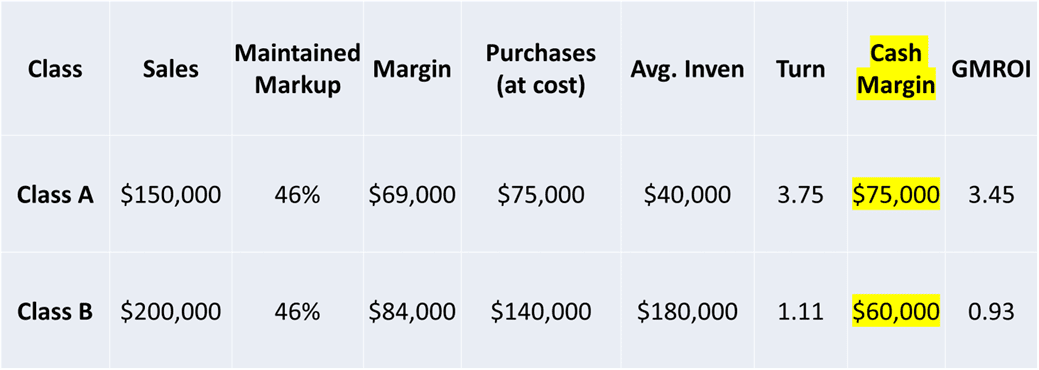
If you only looked at sales and margins, you might conclude that Class B is more profitable than Class A. But it’s not, and here’s why. Class B had more sales and generated $84,000 in margin. However, the purchases were nearly double, and the average inventory was 4.5 times higher. As such, we had a ton of money tied up in Class B, and that robbed us of profitability.
Look at the column I highlighted, labeled “Cash Margin.” Let me define that. Cash Margin is Net Sales minus Purchases at Cost. Look at Class B, and think about this in terms of your bank balance. You wrote checks to vendors for $140,000, and your customers gave you cash, credit cards, etc., for $200,000. The net effect on your bank account was $60,000. In Class A, you wrote checks to vendors for $75,000, and your customer gave you $150,000, so the net effect on your bank account was $75,000, $15,000 higher than Class B.
As such, Class A was $15,000 more profitable.
Now look at GMROI (Gross Margin, Return On Investment). This is calculated by dividing the profit margin achieved by the average inventory. GMROI can be thought of in dollars. If you have a 2.0 GMROI, it means that for every dollar you invest in inventory, you get 2.0 dollars back.
In the example above, Class A’s GMROI is way above Class B’s GMROI. Why? Because our Class B’s inventory was so much higher.
Want to improve your GMROI? There are two levers: margin and inventory. To improve your GMROI, you either increase your margin (get better deals from vendors, buy better so that you take fewer markdowns) or decrease your average inventory (buy closer to the sale, turn the inventory faster).
Obviously, this takes some practice and a proclivity for numbers. This is the “science” of retail, and these are natural laws that cannot be ignored. Once you master them, your store can achieve much, much better cash flow and success!