
Your Website Isn’t Dead—But It’s Not Where Growth Happens Anymore
Let’s start with an uncomfortable truth: you’ve probably spent years perfecting your e-commerce website. Faster load times, better product photography, streamlined checkout, and improved navigation. And while those investments still matter, they’re no longer the primary driver of growth.
The numbers tell a stark story. Traditional e-commerce grew 7.6% from 2022 to 2023, reaching $1.119 trillion in the U.S. That’s respectable but not remarkable—especially when you compare it to social commerce.
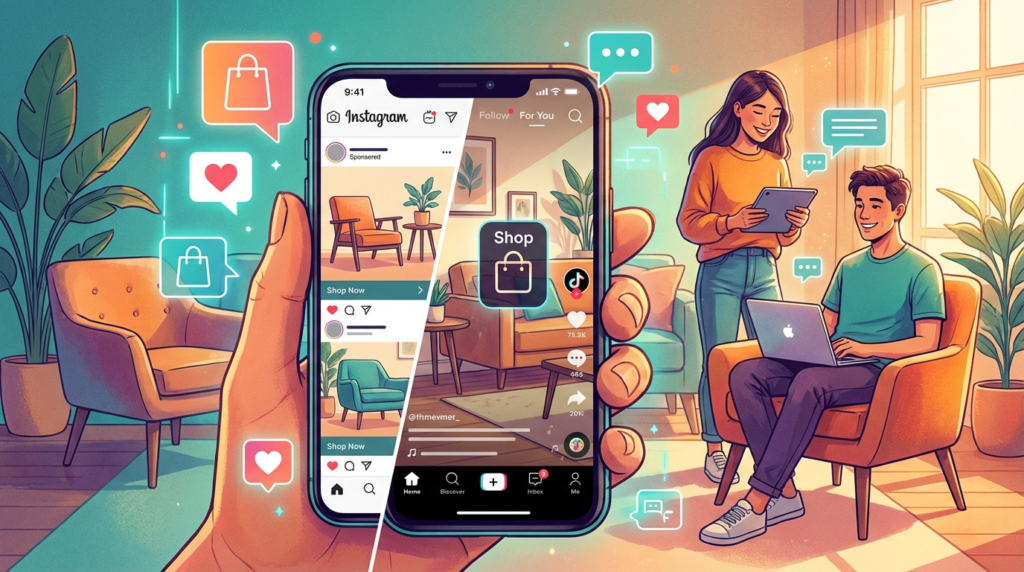
What is Social Commerce? It’s when consumers discover, evaluate, and purchase products directly within social media platforms like TikTok, Instagram, Facebook, YouTube, and Pinterest—without ever visiting your website.
Social commerce is projected to surge from $492 billion globally to $1.2 trillion by the end of 2025—growing three times faster than traditional e-commerce. If you’re not adapting your strategy, you’re essentially watching your competitors take market share while you polish a destination fewer people are visiting.
Why Furniture is Perfect for Social Commerce
Here’s why this matters specifically to furniture retailers:
76% of social media users have bought a product they first saw on social media. And furniture, unlike many categories, is inherently:
- Visual (it photographs beautifully)
- Emotional (people dream about their ideal living spaces)
- Aspirational (people want what they see in styled rooms)
A static product page on your website can’t compete with:
- A beautifully styled room reveal on Instagram
- A TikTok showing how a sofa cleans up after kids and pets
- A designer explaining on YouTube why a dining table works perfectly in small spaces
- A before-and-after home transformation that gets 2 million views
This is how consumers shop now—by imagining what their home could look like, not by scrolling through 40 thumbnail images on a product listing page.
The Generational Shift You Can’t Ignore
Gen Z and Millennials are expected to drive 62% of social commerce spending in 2026. And before you think “young people aren’t buying furniture,” consider this:
These demographics are:
- Furnishing first homes and apartments
- Setting up remote workspaces
- Buying investment properties and Airbnbs
- Upgrading furniture as they start families
And they aren’t browsing websites—they’re scrolling feeds.
The Data That Should Wake You Up
- 60% of B2C brands now acquire customers through social media
- Only 11% purchase immediately, but 44% return to buy online later, and 21% buy in-store after seeing a product on social media.
- Consumers spend far more time on social platforms than on retailer websites.
What does this mean? Your social media presence isn’t “nice to have”—it’s your primary showroom for the next generation of customers.
Five Action Steps to Win With Social Commerce in 2026
Let me be direct: if your social media presence is weak, inconsistent, or purely promotional (just posting sales and “new arrival” announcements), you are leaving substantial money on the table. Here’s how to fix it.
Action Step #1: Launch a Weekly “See It Styled” Video Series
The biggest barrier to furniture purchases online is “I can’t visualize it in my space.” Video content solves this problem instantly.
What to Create:
- Short room transformations (15-30 seconds)
- “Get This Look” breakdowns showing how to style a complete room
- Small-space solutions (huge opportunity—many people live in apartments)
- Seasonal or trend-based room designs
- Style tips using your actual inventory
Why This Works:
- Builds your authority as a design resource
- Removes the visualization barrier
- Drives engagement (social algorithms favor video content)
- Gives potential customers reasons to visit your store or website
Platform Priority: Start with Instagram Reels and TikTok—these platforms are aggressively pushing video content and will provide you with organic reach.
Action Step #2: Create an In-Store Social Content Studio
Stop chasing influencers and start creating your own steady flow of content using the assets you already have: your showroom, displays, and people.
How to Set It Up:
- Designate one corner of your store with a clean wall and neutral flooring
- Add ring lighting and ensure good natural light
- Create 1-2 curated room vignettes as backdrops
- Allocate just 60 minutes per week to content creation
What to Film:
- 15-second “New Arrival” videos
- “Today’s Room Setup” styling reels
- Staff favorites: “Why I Love This Sofa.”
- Product demos: fabrics, recliner mechanisms, drawer quality
- Price-point spotlights: “Best Sectionals Under $1,999.”
Why This Is a Game-Changer:
- You control the output (no negotiating with influencers)
- Zero additional contracts or costs
- You build trust with your own team’s voice
- Customers get real, honest, visual proof of what you sell
- It’s sustainable—just one hour per week
The Problem This Solves: Most furniture retailers have impressive displays inside their stores, but they often lackvisibility outside. A simple content studio fixes that immediately.
Action Step #3: Turn Your Best Sellers Into Shoppable Social Posts
What is Shoppable Content? It’s posts, reels, or stories on social media where users can click on a product and purchase directly—without leaving the platform.
Where to Enable Shopping:
- Instagram Shop
- Facebook Shop
- TikTok Shop
How It Works: You tag products in your content, and when users tap them, they see pricing, details, and a “Buy” button.
Why This Matters: You’re reducing friction. Every additional click between “I want this” and “I bought this” loses customers. Shoppable content turns passive scrolling into direct revenue.
Action Step #4: Build a Social-First Customer Service Layer
Furniture shoppers ask numerous questions before making a purchase, including dimensions, fabric durability, delivery times, and assembly requirements. If you answer those questions fast on social media, your conversion rates skyrocket.
Where to Respond Immediately:
- Instagram DMs
- Facebook Messenger
- TikTok comments
- Story Q&As
What This Looks Like in Practice:
- Customer comments on your reel: “Does this come in gray?”
- You respond within 2 hours: “Yes! We have it in 4 shades of gray. DM us, and we’ll send photos.”
Why Speed Matters: Social media users expect real-time interaction. A 24-hour response feels like neglect. A 2-hour response feels like exceptional service.
Action Step #5: Introduce Monthly Furniture Drops
What is a “Drop”? It’s a concept borrowed from fashion and streetwear—a limited-time product launch that creates a sense of urgency and buzz.
How to Apply It to Furniture:
- Release a monthly curated collection or featured product
- Promote it with teaser content and countdowns
- Offer social-exclusive perks (free delivery, bundle pricing, first access)
- Host a launch-day live shopping event on Instagram or TikTok
Why This Works:
- Creates urgency (scarcity drives purchasing decisions)
- Gives people a reason to follow you consistently
- Generates repeat engagement (people come back each month)
- Makes your brand feel dynamic and current
What Platforms Should You Prioritize?
Not all platforms are equal. Here’s where to focus based on your target customer:
TikTok: Best for reaching Gen Z and younger Millennials. Short, entertaining, trend-driven content performs well. TikTok Shop is aggressively growing.
Instagram: Essential for visual storytelling and reaching Millennials and Gen X. Reels, Stories, and Shopping features are all critical.
Facebook: Still dominant for reaching older demographics and local communities. Facebook Marketplace is particularly strong for furniture.
Pinterest: Functions as a visual search engine for home design inspiration. Long content lifespan—pins can drive traffic for months.
YouTube: Ideal for longer-form content like room tours, product reviews, and “how-to style” tutorials. YouTube’s “shelf” feature enables direct product sales.
My Recommendation: Start with Instagram and TikTok—they offer the best organic reach in 2026. Add Facebook for local targeting and customer service.
The Mindset Shift Required
Here’s what needs to change at the leadership level:
Old Thinking: “Social media is for brand awareness.”
New Reality: Social media is a direct sales channel and your primary source of inspiration.
Old Thinking: “Our website is our digital storefront.”
New Reality: Social platforms are where customers window shop. Your website is where they finalize purchases.
Old Thinking: “We need to perfect our website before investing in social.”
New Reality: Most customers will see your social content before they ever visit your website. If your social presence is weak, they’ll never get to your site.
Your Q1 2026 Social Commerce Checklist
Week 1:
- Audit your current social presence across platforms
- Set up business accounts with shopping features enabled
- Identify your best-selling products to feature first
Week 2-3:
- Create your in-store content studio
- Film your first 4 weeks of content (one hour of filming = one month of posts)
- Schedule content using Meta Business Suite or a tool like Later
Week 4:
- Tag products in your first shoppable posts
- Implement a social customer service response protocol
- Plan your first monthly “drop” for next month
Ongoing:
- Post 4-5 times per week on Instagram and TikTok
- Respond to all DMs and comments within 2-4 hours
- Measure what works (engagement, click-throughs, conversions) and do more of it
The Bottom Line
Your website still matters—but it’s no longer where the customer journey begins. Social commerce is where inspiration happens, where trust is built, and increasingly, where purchases are completed.
The furniture brands that master social commerce in 2026 will dominate the marketplace by 2028. The question isn’t whether to invest in social commerce—it’s whether you can afford not to.
Remember: Furniture shopping is no longer led by traditional e-commerce. The numbers make that impossible to ignore.