The Customer Journey is No Longer Linear
Picture this scenario: A customer sees your sectional sofa on Instagram. She clicks through to your website on her phone, browses the dimensions and fabric options, but doesn’t make a purchase. The next day, she visits your physical store, sits on that exact sofa, takes photos, but still doesn’t buy. Three days later, she’s on her laptop, adds the sofa to her cart with her chosen fabric, but abandons checkout because she has questions about delivery.
Did you lose this customer? Not yet—but only if you have an omnichannel strategy in place.
What is Omnichannel? It’s creating a seamless, integrated shopping experience across all customer touchpoints—social media, website, mobile app, physical store, customer service, email—so that customers can move fluidly between channels without starting over or losing information.
The statistics are compelling: Companies with robust omnichannel strategies retain 89% of their customers, compared to just 33% for those with weak omnichannel capabilities (Harvard Business Review).
In furniture retail, specifically, where the average purchase cycle can span weeks and involve multiple touchpoints, omnichannel isn’t a luxury—it’s a necessity for survival.
Why Omnichannel Matters More for Furniture Than Almost Any Other Category
Furniture purchases are:
- High consideration (people research extensively before buying)
- High value (average transaction often $1,000+)
- Emotional (people want to be certain before committing)
- Complex (dimensions, materials, delivery, and assembly all factor in)
Your customers will interact with your brand across multiple channels before purchasing. The question is whether those interactions feel connected or disjointed.
The Five Omnichannel Imperatives for Furniture Retailers in 2026
Imperative #1: Unified Customer Data Across All Touchpoints
The Problem: A customer browses your website, adds items to their cart, then visits your store. Your sales associate has no idea what they looked at online. The customer has to start from scratch.
The Solution: Implement a CRM (Customer Relationship Management) system that captures and shares customer data across all channels.
What is a CRM? Think of it as a central database that tracks every interaction a customer has with your brand—website visits, email opens, store visits, purchases, customer service calls—and makes that information accessible to everyone who serves that customer.
What This Looks Like in Practice:
- Customer browses sofas online → adds one to cart
- The next day, she visits your store
- Your sales associate greets her: “I see you were looking at our Carlson sectional online. Let me show you that one and a few similar options.”
- Customer feels valued and understood (not like she’s starting over)
Technology Requirements:
- Cloud-based CRM compatible with your e-commerce platform
- Integration with your point-of-sale (POS) system in stores
- Mobile accessibility for sales associates
ROI Impact: Customers with connected experiences spend 30% more over their lifetime compared to those with disconnected experiences.
Imperative #2: Real Inventory Visibility Everywhere
The Problem: Nothing frustrates customers more than falling in love with a product online, driving to your store, and discovering it’s out of stock—or worse, never finding out until they’ve already bought it.
The Solution: Real-time inventory integration across all sales channels.
What This Means:
- Your website shows actual in-stock quantities (or at minimum, “in stock” vs “order for delivery”)
- Store associates can check inventory across all locations from a tablet
- Customers can reserve items online and pick up in store
- If an item is out of stock, customers immediately see delivery timeframes
What is Real-Time Inventory Integration? It’s a system where every sale—whether online or in-store—is immediately updated across your inventory count. When someone buys a chair in your Dallas store, that chair is instantly removed from available inventory on your website.
The Competitive Advantage: According to research, 87% of consumers consider it important to know a product’s real-time availability before shopping. If your competitors offer this service and you don’t, you’re likely to lose sales.
Imperative #3: Buy Online, Pick Up In Store (BOPIS) & Flexible Fulfillment
What is BOPIS? It stands for “Buy Online, Pick Up In Store”—customers purchase items on your website and collect them at your physical location.
Why This Matters Now: Following the pandemic, customers have come to expect flexible fulfillment options. For furniture specifically:
- Smaller items (lamps, décor, pillows) are perfect for immediate pickup
- Customers can inspect items in person before taking them home
- You save on delivery costs
- You get the customer in your store (where they often buy additional items)
Beyond Basic BOPIS: Innovative retailers are offering:
- Curbside pickup (customer never enters the store)
- Reserve online, try in store (hold items for customer fitting/approval)
- Ship from store (turning retail locations into mini distribution centers)
- Endless aisle (if an item is out of stock in-store, an associate orders it for delivery right there)
Implementation Requirement: Your inventory management system must be integrated with your e-commerce platform to ensure seamless operation.
Imperative #4: Augmented Reality for True Visualization
One of furniture retail’s greatest challenges has always been the visualization gap—customers struggle to imagine how products will look in their actual spaces.
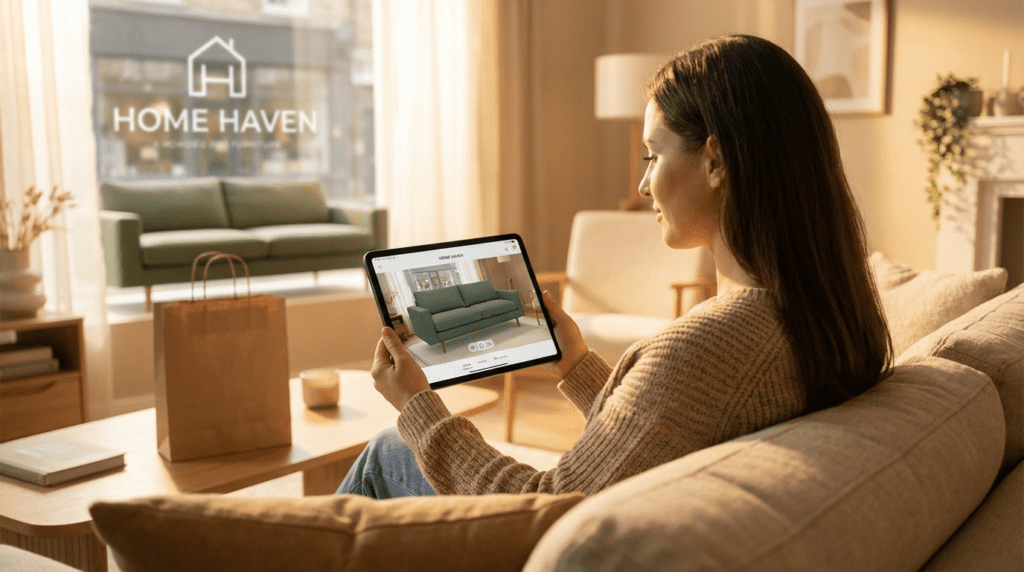
What is Augmented Reality (AR) in Retail? It’s technology that lets customers point their phone or tablet at their living room and virtually “place” your furniture in their space to see how it looks, fits, and coordinates with existing décor.
Why This is an Omnichannel Tool: AR bridges the online-offline gap:
- Customer browses your website → uses AR to visualize the sofa in her living room
- Feels confident enough to purchase OR
- Visits your store already knowing which items will work in her space
The Business Impact:
- Reduces returns (customers see accurate scale and style before buying)
- Increases conversion (removes the #1 barrier to online furniture purchases)
- Builds confidence (customers feel certain about their decision)
Current Adoption: Leading furniture retailers, such as Wayfair, have seen over 1 million downloads of apps with AR features. Consumers now expect this capability.
Implementation: Many e-commerce platforms (Shopify, BigCommerce) offer AR integration as add-ons. The technology is far more accessible and affordable than it was even two years ago.
Imperative #5: Consistent Messaging & Branding Everywhere
This may sound obvious, but it is frequently overlooked: your brand voice, visual identity, product information, pricing, and customer service should be consistent whether a customer interacts with you on Instagram, your website, in your store, or via email.
Where Retailers Fail:
- Social media has a casual, fun voice → Website is formal and corporate
- Website shows different pricing than in-store tags
- Product descriptions vary between online and in-store signage
- Customer service email responses contradict what sales associates say in person
Why Consistency Matters: Every inconsistency erodes trust. Customers question whether they’re getting the best price, the accurate information, or the same level of service.
The Fix:
- Brand guidelines that extend across all channels (tone, visuals, messaging)
- Single source of truth for product information and pricing
- Unified training for all customer-facing teams (in-store, online chat, phone support)
- Regular audits to ensure consistency
The Technology Stack You Need (Explained in Plain English)
Building a true omnichannel experience requires some technology investment. Here’s what you need and why:
-
Customer Relationship Management (CRM) System
- What it does: Tracks all customer interactions across channels
- Examples: HubSpot, Salesforce, Zoho CRM
- Cost: $50-$300/month, depending on size
- Why you need it: Unified customer view
-
E-commerce Platform with Omnichannel Capabilities
- What it does: Powers your website with inventory, CRM, and POS integration
- Examples: Shopify Plus, BigCommerce, Adobe Commerce
- Why you need it: Central hub connecting all sales channels
-
Point of Sale (POS) System with Cloud Integration
- What it does: Processes in-store sales and syncs with online inventory
- Examples: Square, Lightspeed, Clover
- Why you need it: Real-time inventory accuracy
-
Inventory Management System
- What it does: Tracks stock levels across all locations in real-time
- Examples: NetSuite, Fishbowl, TradeGecko
- Why you need it: Prevents overselling and enables BOPIS
-
Marketing Automation Platform
- What it does: Sends personalized emails/texts based on customer behavior
- Examples: Klaviyo, Mailchimp, ActiveCampaign
- Why you need it: Nurture customers across their journey
Don’t Let Technology Overwhelm You: Many modern e-commerce platforms bundle several of these capabilities together. Start with one integrated solution rather than trying to connect multiple separate systems.
Your Q1 2026 Omnichannel Roadmap
Month 1: Assess & Plan
- Audit your current customer journey across all touchpoints
- Identify the biggest gaps (Where are customers getting frustrated or dropping off?)
- Evaluate your technology stack—what integrations are missing?
- Set measurable goals (e.g., “Increase cross-channel customer retention by 15%”)
Month 2: Implement Quick Wins
- Ensure inventory visibility on your website
- Train store associates to look up customer browsing history
- Set up basic BOPIS for small items
- Create consistent product descriptions across all channels
Month 3: Roll Out Advanced Capabilities
- Implement AR visualization on your website
- Launch flexible fulfillment options
- Integrate marketing automation based on customer behavior
- Begin measuring omnichannel customer metrics
Measuring Omnichannel Success
How do you know if your omnichannel strategy is working? Track these metrics:
- Cross-Channel Customer Percentage
- What it is: % of customers who interact with your brand on 2+ channels
- Why it matters: These customers spend significantly more
- Omnichannel Conversion Rate
- What it is: Conversion rate of customers who use multiple channels vs. a single channel
- Benchmark: Omnichannel customers typically convert 2-3x higher
- BOPIS Adoption Rate
- What it is: % of online orders chosen for pickup vs. delivery
- Why it matters: Indicates successful channel integration + gets customers in stores
- Customer Lifetime Value (CLV) by Channel Mix
- What it is: Total revenue per customer segmented by the channels they use
- Why it matters: Proves ROI of omnichannel investment
- Cart Abandonment Recovery Rate
- What it is: % of abandoned carts recovered through cross-channel marketing
- Why it matters: Shows the effectiveness of unified customer data
The Competitive Reality
Here’s the truth: your customers are already shopping omnichannel, whether you’re ready or not. They’re comparing your Instagram content to your in-store experience. They’re checking your website pricing while standing in your showroom. They expect the cart they built on their phone to be there still when they open your website on their laptop.
If those experiences feel disconnected, they’ll find a retailer where everything flows seamlessly.
The furniture retailers winning in 2026 aren’t the ones with the lowest prices or the biggest showrooms—they’re the ones who make shopping effortless across every touchpoint.
Final Thought: Start Where You Are
Omnichannel doesn’t mean you need to implement everything at once. Start with the biggest pain point in your customer journey and solve that first.
Is it inventory visibility? Fix that.
Is it disconnected customer data? Implement a CRM.
Is it a lack of flexible fulfillment? Start with basic BOPIS.
Progress beats perfection. Every step toward a more connected customer experience gives you a competitive advantage.
The customers are ready. The technology is accessible. The question is: are you ready?