
The David vs. Goliath Story is Changing
If you’ve been in furniture retail for more than a decade, you remember when only the big players—the Top 100 chains with massive budgets—could afford sophisticated digital marketing. Those billion-dollar retailers had teams of 20 or more people solely handling search engine optimization (SEO), which is the practice of making your website more visible when people search for furniture on Google. They could afford customer segmentation (grouping customers by behavior and preferences), advanced content creation, and e-commerce optimization that Main Street stores could only dream about.
That world is disappearing. Fast.
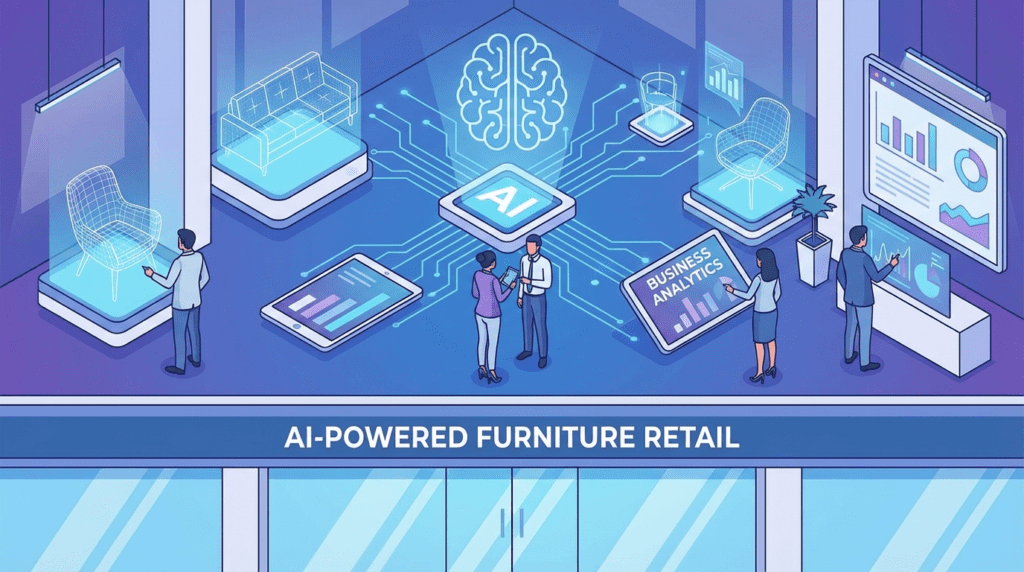
Artificial Intelligence—the technology that enables computers to perform tasks that typically require human intelligence—is democratizing capabilities that were once exclusive to retail giants. And if you’re not paying attention, you’re leaving serious money on the table in 2026.
What’s Actually Changing (And Why You Should Care)
-
Generative Engine Optimization: The New SEO
Remember when customers searched “sofa near me,” and your job was to rank high on Google? The traditional approach to SEO still matters, but consumer behavior has undergone a fundamental shift.
Today’s shopper opens ChatGPT or another AI assistant and asks: “What’s the best sectional sofa for a family of four with two dogs, budget under $2,500, modern style, stain-resistant fabric?”
That’s not a Google search—it’s a conversation. And if your product information isn’t optimized for these AI-powered tools, you’re invisible to this customer.
What is Generative Engine Optimization (GEO)? Think of it as SEO’s more sophisticated cousin. Instead of just optimizing for search engines like Google, GEO ensures your products can be discovered and recommended by AI chatbots and language models. This requires richer product data, including lifestyle use cases, detailed feature context, comprehensive metadata, and even annotations on your product images.
The Business Impact: Retailers who combine traditional SEO with GEO strategies are seeing up to 20% lifts in product discoverability. That’s 20% more potential customers finding your products instead of your competitors’.
What You Need to Do:
- Audit your product descriptions—are they detailed enough to answer specific customer questions?
- Add lifestyle context: “Perfect for families with young children” or “Ideal for small apartment living.”
- Ensure your metadata (the behind-the-scenes information about your products) is consistent across descriptions, tags, and image labels.
- Partner with your web team or agency to implement GEO best practices
-
AI-Powered Personalization: Making Every Customer Feel Like Your Only Customer
Large retailers once employed entire teams to analyze customer data and create personalized shopping experiences. Now, AI does this automatically—and it’s available to retailers of every size.
What is AI Personalization? It’s technology that analyzes how individual customers browse your website, what they click on, how long they spend on certain pages, and their purchase history—then automatically shows them products they’re most likely to buy.
A premium locker brand called Mustard Made implemented personalized recommendations based on browsing behavior. The results? A 15% increase in average order value and 158% revenue growth. These aren’t lottery-winning numbers—they’re the new baseline for retailers who embrace AI personalization.
Why This Matters to Your Bottom Line:
- Higher conversion rates (more visitors actually buying)
- Increased average order values (customers buying more per transaction)
- Improved customer loyalty (people return when experiences feel personalized)
-
Agentic Commerce: AI That Actually Buys For Your Customers
This is where things get really interesting—and potentially disruptive if you’re not prepared.
What is Agentic Commerce? It’s AI technology that can complete purchases on behalf of consumers. A customer can instruct ChatGPT to “Buy me the best-rated leather recliner under $1,000 from a reputable retailer,” and the AI can actually execute that transaction.
This isn’t science fiction—it’s happening right now. The technology has only been widely available for about six months and is already transacting hundreds of billions of dollars globally.
What This Means for Your Business:
- Your products need to be AI-discoverable (see GEO above)
- Your e-commerce platform needs to support seamless transactions
- Your product data must be trustworthy and comprehensive—AI agents prioritize retailers with reliable information
- Payment processing must be frictionless (many platforms already support this through services like Stripe)
The Privacy Question Every Executive Asks
“If we use AI, is our customer data safe? What about competitive information?”
It’s a legitimate concern. Here’s what you need to know:
Enterprise data on reputable platforms is siloed. Your customer information isn’t being shared with competitors. Major AI providers understand that violating enterprise trust would destroy their business model—they have every incentive to protect your data.
However, discipline is critical:
- Implement strong password protocols across your organization
- Don’t share sensitive business information through public AI tools
- Work with established platforms that have clear data privacy policies
- Consider enterprise-level AI solutions with specific security agreements
The Resource Question: “We Don’t Have a Tech Team”
Here’s the counterintuitive truth: AI is actually reducing the technology burden for smaller retailers, not increasing it.
Tasks that previously required large teams, such as content creation, customer segmentation, inventory optimization, and email marketing personalization, can now be handled by AI-powered tools with minimal technical expertise.
Labor is decreasing while results are increasing. That’s the promise AI is actually delivering on in 2026.
Your Q1 2026 Action Plan
If you’re a Marketing Director or President reading this, here’s what you should be doing this quarter:
Immediate Actions (This Month):
- Audit your product content—is it rich and detailed enough for AI discoverability?
- Research AI personalization tools compatible with your e-commerce platform
- Review your website’s checkout process—can it handle AI-initiated purchases?
Short-Term Strategy (Next 60 Days):
- Partner with your technology vendors to implement GEO
- Begin testing AI-powered personalization on your website
- Train your marketing team on AI tools for content creation and customer insights
Long-Term Competitive Advantage (Q2-Q4 2026):
- Develop a comprehensive AI strategy across all customer touchpoints
- Measure results consistently—track discoverability, conversion rates, and customer lifetime value
- Stay informed on emerging AI capabilities in retail
The Bottom Line
AI isn’t replacing human decision-making in furniture retail—it’s amplifying it. The retailers who thrive in 2026 won’t necessarily be the biggest; they’ll be the ones who execute AI strategies with consistency and discipline.
The playing field is leveling. The question is: will you take advantage of it or watch your competitors pull ahead?
The real value comes from execution and consistency. AI doesn’t replace that—it amplifies the need for it.